Live-in Caregiver Jobs in Europe: How They Work (2026)
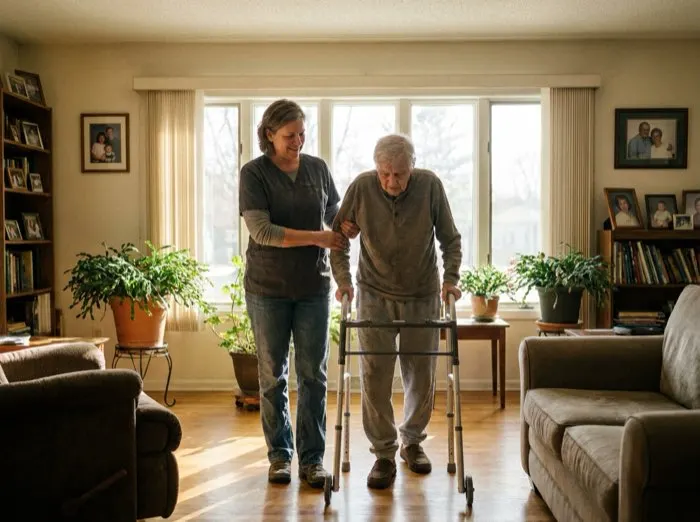
Live-in care - moving into an elderly person's home and providing daily support - is one of the largest hidden labour markets in Europe. Hundreds of thousands of carers, mostly women from Central, Eastern and Southern Europe and Latin America, keep older Europeans out of institutions. The arrangements range from fully legal and regulated to entirely informal. Before you accept a live-in job anywhere, understand which model you are stepping into.
The main models, country by country
- Austria - the legal benchmark: live-in carers (Personenbetreuer) register as self-employed with a trade licence and typically work two-week rotations, alternating with a colleague. Families get subsidies for using registered carers, keeping the sector formal.
- Germany - the grey zone: so-called 24-Stunden-Pflege is widespread but legally awkward; carers are often posted via Eastern European agencies, and German courts have ruled that on-call night hours count as paid working time. Contracts frequently do not reflect that.
- Spain and Italy - the household-employee model: the Spanish interna and Italian badante are directly employed by families under special household-employment regimes with their own minimum wages, rest rules and social-security registration. Legal, but enforcement inside private homes is weak.
- Northwestern Europe: in the Netherlands and the Nordics, live-in care barely exists formally; care is delivered by shift-based facility and home-care services.
Pay, room and board
Live-in pay is quoted many ways: monthly wages (Spain, Italy), daily rates (Austria commonly around €55 to €95 per day for self-employed carers), or lump monthly sums from agencies. Room and board are always included, which is why net savings can beat higher-paid facility jobs. Always establish: gross or net, who pays social insurance, what happens during the client's hospital stays, and how travel between rotations is covered. Treat any figure as negotiable and verify what similar carers earn.
Working time: the hard question
The core tension of live-in work is that you are present 24 hours but paid for fewer. Serious arrangements define daily working hours, guaranteed rest, free time and night-duty compensation in writing. If a contract says available around the clock without addressing rest, that is a problem - both for your health and, in employment-model countries, for legality. Dementia care in particular can mean broken nights; ask directly how they are compensated.
Red flags
- Agencies charging you placement fees - nobody legitimate charges workers for a job offer.
- No written contract, or a contract in a language nobody will translate for you.
- Confusion about who your employer actually is (family, agency, foreign posting company).
- Passport-holding, wage withholding for debts, or promises to sort papers later - walk away.
Permits still apply
Living in a family's home does not exempt you from immigration rules. EU citizens can work anywhere in the EU; non-EU carers need a legal work basis in each country, and household work is one of the sectors where informality is most tempting and most dangerous. See our guide to EU work permits and visas explained for the framework, and how EU employer sponsorship works for the employer side.
Questions to ask before accepting any live-in job
Treat the interview as two-way and get answers in writing: Who exactly is my employer and in which country is my contract registered? What are my daily working hours, and how are nights counted and paid? Which days and hours are fully mine, and can I leave the house then? What happens to pay and lodging if the client goes to hospital or dies mid-rotation? Who pays travel at the start and end of each rotation? Is there a second carer or family backup, or am I alone with the client around the clock? A serious family or agency answers all of these without irritation; evasion is your answer.
Health, isolation and sustainability
Experienced live-in carers say the hardest part is not the tasks but the isolation: you live at your workplace, often in a village, in someone else's rhythm. Rotation models exist precisely to make this sustainable - two to six weeks on, then real time off at home. Guard that boundary. Insist on your daily rest, keep contact with other carers (large online communities exist in Polish, Romanian, Slovak and Spanish), and document your hours from day one. If conditions collapse - no rest, verbal abuse, withheld wages - leaving is legitimate; labour inspectorates and migrant-support NGOs in every EU country handle household-work complaints.
This is general information, not legal advice. Check the rules of the specific country - the EU's EURES portal (eures.europa.eu) links to national authorities.
Families and agencies across Europe search for live-in carers. Create your free profile on Workuro - free, no credit card, and employers contact you directly.
Ready to be found?
Create your profile in 2 minutes. Free, no credit card.
Keep reading