Forklift Operator Jobs in Iceland for Foreign Workers (2026)

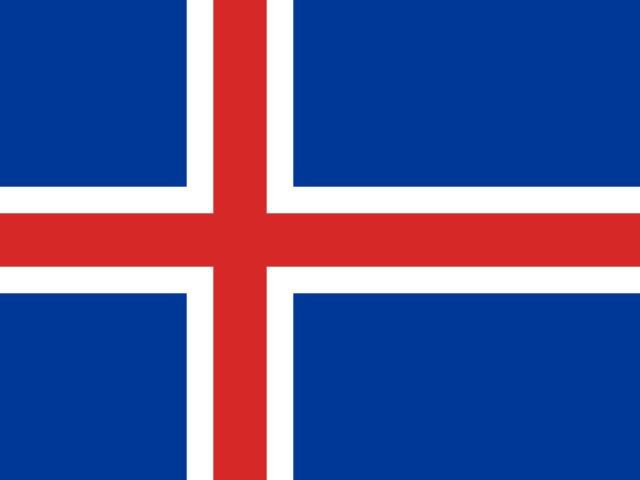 Iceland
Is Iceland the Right Target for Your Forklift Career?
If you are looking for forklift operator jobs in Iceland from outside the European Union, we need to start with direct honesty. Iceland is a small island nation with a total population of around 390,000 people. Because the population is small, the overall job market for dedicated forklift operators is quite limited compared to mainland Europe.
Most forklift roles in Iceland exist inside fish processing plants, import warehouses, port terminals, and construction supply yards. To hire a worker from outside the EU or European Economic Area (EEA), an Icelandic employer must legally prove that no qualified person could be found inside Iceland or the EEA. Because standard forklift driving is a common skill, employers rarely sponsor non-EU work permits for simple warehouse roles.
If your main goal is simply to get a job in Europe quickly as a forklift driver, places like Norway, Poland, or the Netherlands offer much higher hiring volumes and more open visa pathways for machinery operators. However, if you have specialized experience in seafood cold storage, heavy port machinery, or fish processing logistics, Iceland is still a viable option. You just need to understand how the process works before spending your time applying.
Where Forklift Operators Work in Iceland
Logistics and manufacturing in Iceland are clustered in a few key geographic locations. Knowing these specific regions will help you tailor your profile and target companies that actually hold work permit quotas.
- Höfuðborgarsvæðið (The Capital Region): This includes Reykjavík, Hafnarfjörður, Kópavogur, and Garðabær. Hafnarfjörður and Reykjavík hold the main shipping harbors and distribution centers for major supermarkets and logistics firms like Eimskip and Samskip. This region has the highest concentration of reach trucks and counterbalance forklifts operating in indoor, temperature-controlled facilities.
- Reykjanesbær and Keflavík Airport: Located about 45 minutes from the capital, the area around Keflavík International Airport handles air cargo import and export. Operators here handle palette movers and heavy forklifts for air freight containers.
- Grundartangi Industrial Area: Located in the west of Iceland near Akranes, Grundartangi is a major heavy-industry port home to aluminum smelters and industrial material suppliers. Forklift work here involves large-capacity diesel forklifts handling raw industrial materials and metal exports.
- Coastal Seafood Hubs (Akureyri, Vestmannaeyjar, Grindavík): Fishing ports across the north, south, and Westfjords rely on specialized forklift drivers who move heavy tubs of fresh fish from vessels directly into cold storage or processing lines.
Licences and Certification: Vinnueftirlitið
You cannot legally operate a forklift in Iceland on a standard foreign driving licence or a general international certificate. Iceland enforces strict machinery safety regulations managed by Vinnueftirlitið (The Administration of Occupational Safety and Health).
To drive a forklift in Iceland, you need an official Icelandic heavy machinery licence known as a Vinnuvélapróf. Forklifts fall under specific categories governed by Vinnueftirlitið:
- Category J (Lyftarar): Covers all standard powered industrial forklift trucks, including counterbalance, reach trucks, and pallet stackers.
- Foreign Licence Transfers: If you hold an official forklift licence from a country outside the EU, Vinnueftirlitið will evaluate your training documentation. In almost all cases, you must still complete a short practical assessment or a localized safety course in Iceland before your Icelandic licence card is issued.
- Language Requirements: Vinnueftirlitið safety courses and tests are conducted in Icelandic and English. You do not need to speak fluent Icelandic to take the test, but you must have at least an intermediate (B1 or B2) level of English to understand safety instructions, load capacity charts, and written questions.
Work Permits and Non-EU Hiring Rules
Workers coming from South Asia, Africa, Latin America, the Balkans, or Central Asia must secure a valid work permit before entering Iceland for employment. You cannot travel to Iceland on a tourist visa and start working or convert your status locally.
The permit process is handled jointly by two government agencies: Útlendingastofnun (The Directorate of Immigration) processes your residence permit, while Vinnumálastofnun (The Directorate of Labour) approves your work permit.
The hiring process follows these mandatory steps:
- The Job Offer: An Icelandic employer must offer you a full-time contract that meets local labor market standards.
- The Local Labor Market Test: The employer must advertise the open role locally in Iceland and across the EEA for a set period. Vinnumálastofnun will only approve your permit if no local candidates applied or matched the job requirements.
- Union Approval: The employment contract is submitted to the relevant local trade union to verify that your pay and working conditions match national collective agreements.
- Processing Times: Work permit applications for non-EU workers typically take between two to four months to process. You must wait in your home country until the visa and permit are fully granted.
Seasons and Hiring Cycles: Seafood processing and coastal warehouse roles peak during primary fishing seasons in winter and early spring. General import and retail logistics peak ahead of the autumn and holiday shipping rush. Hiring for non-EU workers usually happens two to three months before these peak windows open.
Union Wages and Net Pay in Iceland
Every worker in Iceland is covered by a national collective bargaining agreement negotiated by trade unions. As a forklift driver in a warehouse or processing plant, you will most likely be covered by the Efling trade union (in the capital area and south) or the VR union (for commercial and retail warehouse staff).
These collective agreements set strict minimum wage floors. Employers cannot legally pay you less than the union minimum, regardless of your country of origin.
- Gross Pay Range: A full-time forklift operator working standard daytime hours earns a basic gross salary ranging between 450,000 ISK and 550,000 ISK (Icelandic Króna) per month.
- Shift Premium and Overtime: Working late shifts, cold-storage shifts, or overtime raises total gross earnings significantly. Shift premiums can add 33% to 45% to your hourly rate.
- Net Monthly Pay (Take-Home): Iceland uses a progressive income tax system offset by a monthly personal tax credit (persónuafsláttur). After income tax, union dues (usually 1%), and mandatory pension contributions (4%) are deducted, a standard baseline net monthly income ranges between 340,000 ISK and 410,000 ISK.
- Living Costs Note: While take-home pay seems high in international conversions, rent and food in Iceland are expensive. Employers who offer staff housing or rental assistance dramatically lower your monthly living costs.
Reality Check: What Foreign Workers Get Wrong
- Misconception: You can arrive on a tourist visa and search for a forklift job.
Reality: Working on a tourist status is strictly illegal. Employers face massive fines, and workers risk deportation and entry bans across the Schengen Zone. - Misconception: A forklift licence from home is enough to start work immediately.
Reality: You must have your credentials verified or take an evaluation through Vinnueftirlitið before operating machinery in Iceland. - Misconception: Basic warehouse jobs easily sponsor visas for non-EU workers.
Reality: Non-EU permit approval requires a labor market test. Standalone forklift operators rarely get approved unless they have combined skills in fish processing machinery or cold-chain management. - Misconception: You need to speak fluent Icelandic to work in a warehouse.
Reality: English is widely used in Icelandic logistics and industrial workplaces. Good English skills are mandatory for job safety, but Icelandic fluency is rarely required on day one.
Build Your Workuro Profile for Icelandic Employers
Icelandic employers and recruitment specialists browse Workuro when they need specific skills to fill specialized positions. Because sponsorship involves administrative work for the employer, complete and precise profiles always get prioritized in search results.
To make sure Icelandic hiring teams can find you easily, update your Workuro profile with these exact specifics:
- Detail Your Equipment Types: Do not just list forklift. Explicitly list counterbalance, reach truck, high-rack stacker, or heavy industrial forklifts.
- Include Working Environments: Highlight any experience in cold storage (-20°C environments), seafood processing facilities, or busy marine container ports.
- List Certifications and Safety Courses: Mention your original country machinery card, training hours, and your readiness to undergo the Vinnueftirlitið evaluation.
- Set Your Target Regions: Specify your interest in regions like Höfuðborgarsvæðið (Reykjavík/Hafnarfjörður), Reykjanesbær (Keflavík), or Grundartangi.
- Clarify Language Levels: State your English proficiency clearly (e.g., B2 or fluent), as safety communication is essential for equipment operations.
Keep your profile current, upload accurate detail about your heavy machinery experience, and let employers find you directly when opportunities arise.
Ești gata să fii găsit?
Creează-ți profilul în 2 minute. Gratuit, fără card bancar.
Continuă lectura