Electrician Jobs in the Netherlands for Foreign Workers (2026)
 the Netherlands
The Netherlands has an unusual problem: parts of its electricity grid are full. Grid operators have long waiting lists for new connections, and expanding the network is a national priority. That, plus one of Europe's highest solar-panel densities, has created strong and persistent demand for electricians and grid technicians.
Is 'electrician' regulated in the Netherlands?
Unlike Germany or Sweden, the Netherlands does not have a single state licence you must hold before working as an employed electrician. In practice, though, employers rely heavily on recognised credentials:
- NEN 3140 designations (such as authorised or supervising installation worker) govern who may safely do what on low-voltage installations. Employers assign these after verifying your competence and training.
- Trade qualifications at Dutch MBO level are the reference point. Foreign diplomas can be evaluated through IDW, the Dutch international credential evaluation service, which helps employers understand what your qualification is worth.
- For grid work, operators and their contractors run their own certification and safety-training pipelines.
The permit side for non-EU workers
This is the hard part. The Netherlands has no general shortage-occupation visa for trades. Most non-EU electricians are hired via the single permit (GVVA), where the employer must usually show the role could not be filled locally, or via intra-company routes. Some larger technical employers have experience sponsoring; many small installers do not. Read how EU employer sponsorship works before you apply, so you can target companies that actually sponsor. The official source is the Dutch Immigration and Naturalisation Service (IND).
Where the jobs are
Grid and infrastructure
Grid operators and their contracting partners are hiring at scale for substations, cabling and connection work. These employers tend to be larger, better organised for training, and more open to international recruitment than small firms.
Solar
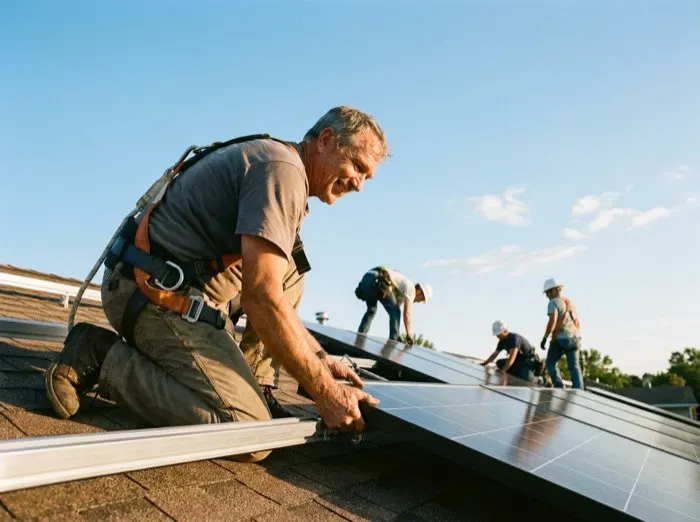
Residential solar cooled off after subsidy changes, but commercial rooftop and large-scale solar continue, and installed systems need maintenance. Solar teams often combine mechanical mounters with a certified electrician who signs off connections.
Installation and industry
Installation companies (electrical plus heating and ventilation) serve construction and renovation, while the port-industrial cluster around Rotterdam employs industrial electricians for maintenance and shutdown work.
Pay and living costs
A qualified electrician in the Netherlands typically earns around 2,700 to 3,800 euros gross per month, with grid technicians and industrial specialists often above that, plus allowances for irregular hours. Collective agreements (CAO) for the technical installation sector set minimum scales. Housing is the main cost problem - rents in the Randstad are high and supply is tight, so ask employers about housing support before you commit.
Practical notes
- English gets you further in the Netherlands than in most of Europe, but Dutch helps for residential work and safety instructions.
- Watch out for dubious agencies charging placement fees. Legitimate employers and agencies do not charge workers for job offers.
How Dutch hiring actually works
Most electricians in the Netherlands are hired in one of three ways, and knowing which door you are knocking on saves time:
- Direct employment with an installation firm or grid contractor - the most stable option, with CAO protections, holiday allowance (a standard 8 percent paid in May) and pension enrolment;
- Via a technical staffing agency (uitzendbureau) - very common for the first Dutch job; check the agency is registered and pays according to the applicable CAO from an early stage;
- Via project subcontractors on large infrastructure jobs - pay can be good, but always confirm who your legal employer is and who is responsible for your permit.
Skills that raise your value fast
Three additions make a foreign electrician noticeably more employable in the Dutch market: familiarity with NEN 1010 (the Dutch installation standard, aligned with international IEC rules, so the gap is smaller than it looks); a VCA safety certificate, which most sites require and which can be taken in several languages; and any medium-voltage or substation experience, because the grid build-out is where structural shortage is worst. Employers frequently fund VCA and NEN training in the first weeks - ask about it in the interview rather than paying for courses yourself in advance. Expect a practical assessment during recruitment: Dutch employers like to see you wire, measure and explain before they commit to sponsorship paperwork.
This is general information, not legal or immigration advice. Check ind.nl and eures.europa.eu for current rules before making plans.
Dutch technical employers search for candidates as much as candidates search for jobs. Create your free profile on Workuro - free, no credit card, and employers contact you directly.
Готові, щоб вас знайшли?
Створіть профіль за 2 хвилини. Безкоштовно, без картки.
Читати далі