Welder Jobs in Estonia for Foreign Workers (2026)
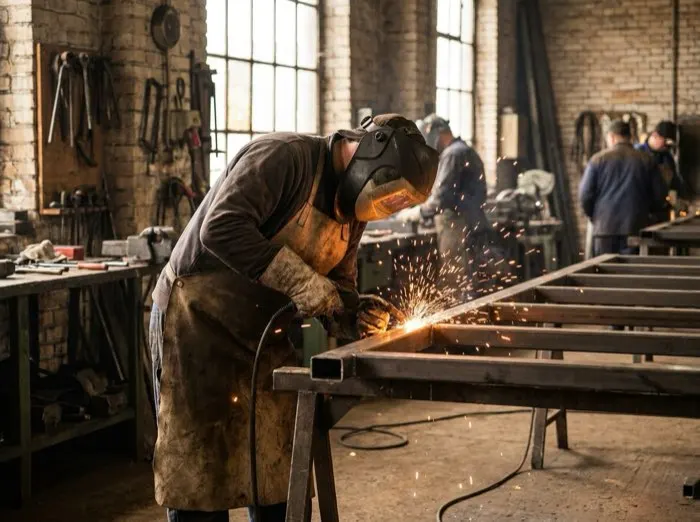
If you are a skilled welder from outside the European Union, Estonia offers steady opportunities in heavy manufacturing, shipbuilding, and structural steel fabrication. While Estonia is a smaller nation than Poland or Germany, its industrial sectors rely heavily on experienced foreign welders to keep up with European export orders. You do not need to pay an agency or search through confusing job boards to find work here. Employers in Estonia pay for recruitment platforms because they need certified workers who can pass immediate practical welding tests.
This guide breaks down exactly how welding recruitment works in Estonia, where the industrial hubs are located, what certificates you must hold, how visas and permits operate, and what you can realistically expect to earn in net monthly wages.
Welder Demand in Estonia: Where the Shops Are
Estonia has a targeted industrial market. Demand for welders is constant, but it is concentrated in specific cities and industrial regions. You will not find heavy welding work in small rural towns, but rather in established industrial centers and coastal port cities.
- Tallinn and Harju County: As the capital region, Tallinn hosts major shipbuilding and repair yards, including the large BLRT Grupp shipyard complex. The surrounding Harju County has dozens of metal fabrication plants producing structural steel components, industrial tanks, and offshore structures for Scandinavian clients.
- Ida-Viru County (Narva, Kohtla-Jarve, and Johvi): This eastern industrial region is the heart of Estonia heavy engineering, energy production equipment, and piping fabrication. The region has a deep industrial history and hosts factories that manufacture heavy industrial pressure vessels, conveyors, and mining machinery.
- Tartu: Located in southern Estonia, Tartu focuses on precision engineering, agricultural machinery manufacturing, and custom stainless steel processing equipment.
- Saaremaa (Kuressaare): This island region is home to world class boatbuilders and marine construction yards, such as Baltic Workboats. They regularly hire aluminum TIG and MIG welders for hull construction and marine fitting.
The hiring cycle in Estonia runs year-round for indoor factory production and workshop fabrication. However, outdoor structural steel erection and marine assembly experience a distinct hiring surge between April and October, when winter weather subsides.
Visas, Work Permits, and the Annual Quota
To work in Estonia as a citizen of a non-EU country, your future employer must register your employment with the Estonian Police and Border Guard Board (known locally as Politsei- ja Piirivalveamet or PBGB). You cannot apply for a work visa without a confirmed job offer and registration from an Estonian employer.
There are two primary pathways for foreign welders entering Estonia:
- Short-Term Employment Registration: This is the most common path for incoming foreign trade workers. Your employer registers your employment online with the PBGB for up to 365 days within a 455-day period. Once registered, you apply for a long-stay D-visa at an Estonian embassy or official visa center in your home region. Processing for short-term registration usually takes 10 to 15 working days, making it the fastest way to start working.
- Temporary Residence Permit for Work (TRP): If an employer wants to keep you long-term, they apply for a residence permit on your behalf. TRP applications take two to three months to process.
You must understand one critical rule about Estonian immigration: the annual immigration quota (sisserandepiirsumma). Estonia caps long-term residence permits for third-country nationals at 0.1 percent of its permanent population each year. Because this quota fills quickly in January, many companies bring skilled welders in on short-term employment registration first, or utilize top-specialist salary exemptions to secure your legal right to work.
Certificates and Standards Employers Look For
Estonian metal fabrication companies manufacture products primarily for Northern European markets, including Finland, Sweden, and Germany. Therefore, quality standards are strict. You cannot rely on unverified experience alone; you must hold standard European welding certifications.
- EN ISO 9606-1 (Steel): This is the universal standard for welder qualification in Estonia. Employers want to see test certificates covering specific welding processes, materials, and positions.
- EN ISO 9606-2 (Aluminum): Highly valuable for marine construction shops in Saaremaa and Tallinn.
- Core Welding Processes: Employers search specifically for international numeric codes on your profile. Process 135 (MAG solid wire) and Process 136 (MAG flux-cored wire) are required for structural steel. Process 141 (TIG) is required for high-pressure pipework, stainless steel, and aluminum fabrication. Process 111 (MMA manual metal arc) is useful for field assembly work.
- Welding Positions: Certificates showing testing in difficult positions like HL-045 (inclined pipe), PE (overhead), or PC (horizontal vertical) immediately stand out to shop managers.
Even if you hold valid certificates issued by testing bodies like TUV or Bureau Veritas, almost every Estonian factory will put you through a practical coupon test on your first day. You will weld a sample joint that undergoes visual inspection and often X-ray or bend testing before you are allowed onto the production floor.
Expected Pay and Net Take-Home Salary in 2026
Estonia uses the Euro (EUR). Pay for welders is typically stated as an hourly gross rate or a calculated monthly wage. Net pay is what enters your bank account after income tax (fixed flat tax rate) and mandatory social deductions are removed.
- Basic Structural MAG Welders (135/136): Expect a starting net salary of 1,200 EUR to 1,500 EUR per month for standard full-time hours.
- High-Spec TIG Pipe and Stainless Welders (141): Experienced pipe welders holding valid EN ISO 9606-1 high-pressure certificates earn between 1,600 EUR and 2,200 EUR net per month.
- Shift Work and Overtime: Many plants operate on two or three shifts. Working night shifts or weekend overtime hours carries mandatory pay premiums, which can increase your monthly net income significantly.
Employers in Estonia often assist foreign workers by arranging fully furnished rental housing near the factory, deducting a moderate fee directly from your salary or providing subsidized shared apartments. Public transportation in Estonian cities is clean, punctual, and inexpensive.
Working Language and Daily Shop Life
Language requirements in Estonian workshops depend entirely on the location and ownership of the company:
- Ida-Viru County (Narva, Johvi): Russian is widely spoken on the shop floor, among team leaders, and in local daily life. If you speak fluent Russian, you will integrate into these workshops immediately without language barriers.
- Tallinn and Industrial Parks: Workplaces use a mix of Estonian, Russian, and English. Most technical documentation, assembly drawings, and safety procedures are provided with clear visual symbols or translated into Russian or English.
- Language Expectations: You do not need to speak Estonian to get hired as a welder. Basic technical English or functional Russian is completely sufficient to handle daily instructions, safety briefings, and blueprint interpretation.
Reality Check: Common Mistakes Foreign Welders Make
Avoid these common misunderstandings when looking for welding work in Estonia:
- Expecting to work without certified tests: Claiming ten years of experience without standard EN ISO documentation will result in skipped applications. Certificates matter first.
- Confusing gross pay with take-home pay: Always calculate your budget based on net monthly salary in Euros, not the gross figure listed on immigration paperwork.
- Ignoring process numbers: Saying "I am a welder" is too vague. Employers filter specifically for Process 135, 136, or 141.
- Arriving on a tourist visa expecting to convert it: You cannot work legally on a tourist visa. Your employment must be formally registered with the PBGB by your employer before you start work on site.
Build Your Workuro Profile to Get Found by Estonian Employers
Estonian industrial recruiters search the Workuro database daily to find qualified welders outside the EU. Because Workuro is completely free for workers, you should set up a complete profile that highlights the exact details Estonian hiring managers search for.
Make sure you list these essential specifics in your Workuro profile:
- Exact Certification Standard: Write down your certification standard, such as EN ISO 9606-1 or EN ISO 9606-2.
- Numeric Process Codes: Specify whether you weld with 135 (MAG solid), 136 (MAG flux-cored), 141 (TIG), or 111 (MMA).
- Welding Positions and Materials: List your tested positions (like HL-045, PE, PC) and material groups (carbon steel, stainless steel, aluminum).
- Languages Spoken: Indicate your level in English or Russian clearly, as this determines which industrial region fits you best.
- Preferred Work Locations: Select Estonia and specific hubs like Tallinn, Ida-Viru County, or Tartu.
Keep your profile details clear, professional, and up to date. Complete profiles appear at the top of employer search results, allowing Estonian industrial companies to view your qualifications and reach out to you directly with legitimate job offers.
নিয়োগকর্তাদের নজরে আসতে প্রস্তুত?
২ মিনিটে আপনার প্রোফাইল তৈরি করুন। ফ্রি, কোনো ক্রেডিট কার্ড লাগবে না।
আরও পড়ুন