How Much Italian Do You Need? The Law, the Employers, and Where to Learn for Free

Two different questions
"Do I need Italian to work in Italy?" is two questions. The first is legal: what does the state require, and when. The second is practical: what does the employer who might hire you expect on the first day. The answers are different, and mixing them up either frightens people away or sends them unprepared. Here they are separately.
What the law requires
- To get a work visa and your first permit: nothing. There is no language test at the consulate or at the Sportello Unico for a first work permit.
- The integration agreement (accordo di integrazione): signed when you apply for your first permit of a year or more, at the Sportello Unico or the questura. It gives you 16 points to start and asks you to reach 30 within two years, by learning Italian to A2, attending a short civic education session, and keeping your permit in order. Points come from certificates, from the CPIA course, from children in school. Failing the agreement can block a renewal, but in practice the course and the session carry most people through.
- The long-term EU permit after five years: A2 Italian, proved by a certificate from one of the recognised bodies (CILS, CELI, PLIDA, CERT.IT) or by the free test organised through the prefettura. Details on integrazionemigranti.gov.it.
- Citizenship: B1 Italian, a higher level, after ten years of residence. Not a worry for the first years.
A2 means: you can handle everyday situations, read a simple notice, fill in a form, describe your work and your family. It is roughly 150 to 200 hours of study from zero. It is not fluency.
One detail that matters for timing: the two years of the integration agreement start from the day you sign it, which is usually the day you apply for your first permit, not the day the card arrives. If the card takes eight months, you have sixteen months left to collect the points. The CPIA course is the surest way to get them, because the certificate it issues at the end of the A2 level is accepted by the prefettura without a separate exam, and the attendance itself is recorded. Workers who wait for the card before enrolling are the ones who run out of time.
What employers actually expect, trade by trade
This is from what Italian employers write in their adverts and tell agencies, not from the law. It varies by region and by the size of the company; a large northern factory expects more than a small southern farm.
- Agriculture: little or none at hiring. Teams are often from one country and a foreman translates. You will learn field words in weeks. Safety instructions are the one thing you must understand, and employers increasingly ask for a short safety course (formazione sicurezza) in Italian or your language.
- Construction: basic Italian for safety and instructions is expected on larger sites, and the mandatory safety training is in Italian. Small firms tolerate less. Reading a work order helps you get the better-paid tasks.
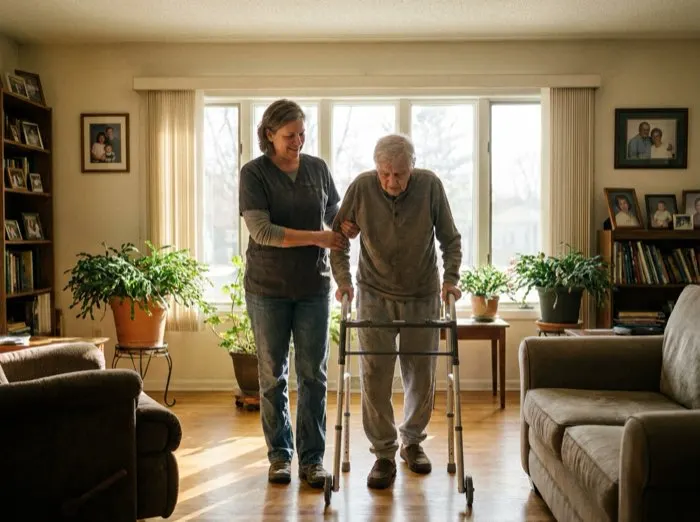
- Caregiving (badante): the highest expectation. You live with an elderly person who speaks only Italian, often a dialect. Families ask for conversational Italian (A2 to B1) and prefer workers who already have it. Many workers start in a two-carer household or with a family that speaks English, and move up.
- Hotels and restaurants: front-of-house needs Italian and usually English; kitchen and housekeeping need basic Italian for instructions and hygiene rules. Seasonal resorts are the most forgiving.
- Warehouse and logistics: basic Italian for safety and the scanner software; the forklift licence course is in Italian. Large logistics hubs around Milan, Bologna and Verona hire many first-year workers.
- Manufacturing and metalwork: A2 is the realistic entry. Reading drawings and quality notes in Italian is what moves you from helper to operator pay.
What the first weeks sound like
Whatever your level, the first weeks at work are mostly listening. Instructions come fast, in a regional accent, often shortened. Three habits help every worker we have heard from. Learn the fifty words of your own trade first, in Italian, before you arrive: the tools, the materials, the verbs for the tasks, the safety words (attenzione, pericolo, fermo). Ask the foreman to repeat once, in front of everybody, rather than guess and do it wrong; Italian supervisors respect the question more than the mistake. And keep a phone note of every new word you hear in a day; ten words a day is A2 in a season.
Where to learn Italian for free
- CPIA: the state adult education centres (Centri Provinciali per l'Istruzione degli Adulti) in every province. Free Italian courses for foreigners from A1 to B1, evening and daytime classes, and the certificate counts for the integration agreement. Enrolment at the local CPIA with your permit or receipt and your tax code. Find yours through the Ministry of Education's CPIA list.
- Before you arrive: free apps and the Italian cultural institutes' online material can take you to A1 while you wait for the visa. Even greetings, numbers and the words of your trade change your first weeks.
- Municipal and volunteer courses: many comuni and parishes run free conversation classes; ask at the comune's immigration desk or the local Caritas.
- Employer courses: some larger employers and agencies pay for Italian lessons under the collective agreement's training rights. Ask; it costs nothing.
- Paid certificates: the A2 exam itself (CILS, CELI, PLIDA) costs roughly 40 to 100 euros. The free prefettura test exists as an alternative for the long-term permit.
How to show language on your CV, honestly
Employers searching a register filter by language. Overstating costs you the job at the first phone call; understating hides you from employers who would take you. Italian families looking for a carer, in particular, will call before they decide, and a two-minute call in Italian is the real test of what the CV says. Use the levels everybody in Europe uses:
- A1: greetings, numbers, basic phrases. Write "Italian: beginner (A1)" if you have started.
- A2: simple conversation about work and daily life. Write it only if you can hold a two-minute call in Italian.
- B1 and above: you can follow instructions, explain a problem, read a contract with help.
- Other languages: list them all. English, Arabic, French, Urdu, Bengali, Hindi and Tagalog are each useful to specific Italian employers and families.
- Learning now: write "Italian: A1, studying for A2 at CPIA". Employers read that as effort, and it is true.
Reality check
- No Italian is not a bar to the first permit: but it is the main reason people stay at the lowest pay for years. The first six months are the time to attend the CPIA course, when it still counts for the integration agreement.
- Dialects: in the south and in the countryside, the Italian you learn in class is not the one you hear. Everybody goes through this; it passes.
- Fake certificates: an A2 certificate bought online is checked against the issuing body's register at the long-term permit stage. It is fraud and it is found.
- English alone: helps in hotels and in some northern companies; it does not replace Italian for the permit or for most trades.
Where this leaves you
These pages go with this one:
- Working in Italy as a non-EU foreigner: permits, jobs and pay
- Caregiver jobs in Italy for foreign workers
- Hotel and hospitality jobs in Italy for foreign workers
- Italy work visa 2026: types, cost, processing time
- Working in Italy from Egypt: visa, permit, costs
The Workuro profile is free, employers search it and contact you, and nobody is ever charged to be listed: create a free profile.
¿Listo para que te encuentren?
Crea tu perfil en 2 minutos. Gratis, sin tarjeta de crédito.
Sigue leyendo