Carpenter and Joiner Jobs in Iceland for Foreign Workers (2026)

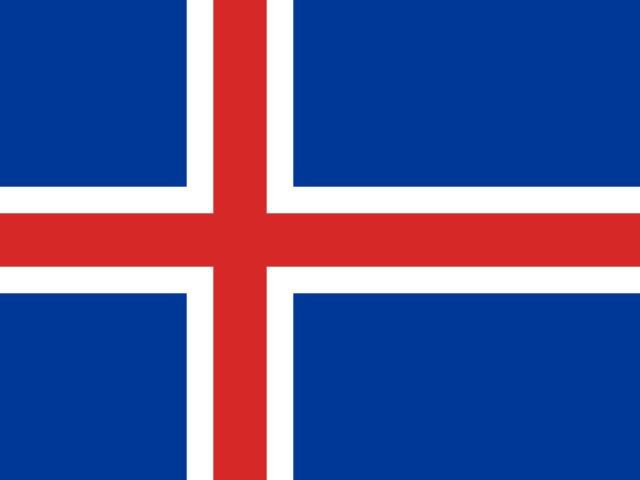 Iceland
Is Iceland the Right Destination for Woodworkers?
Iceland is a small island nation with a population of under 400,000 people. If you are looking for tens of thousands of open woodworking vacancies, Iceland is not the right choice for you. Larger European nations like Germany, Norway, or the Netherlands have far higher total demand for carpenters. However, Iceland maintains a steady need for skilled timber framers, interior joiners, and formwork specialists to support residential building, hotel construction, and infrastructure projects.
If you come from outside the European Union - such as South Asia, Africa, Latin America, Central Asia, or the Balkans - you cannot simply board a flight and start looking for work. You need a formal job offer from an Icelandic employer who is willing to sponsor your work permit before you land. The total number of non-EU carpentry permits issued each year is small, but positions exist for craftsmen who know the trade and understand the local regulations.
Where the Jobs Are: Regions and Hiring Cycles
Most construction activity in Iceland takes place in specific urban and industrial zones. Knowing where employers are building helps you target your applications and profile details effectively.
- Greater Reykjavík Area (Höfuðborgarsvæðið): Includes the capital city, Kópavogur, Hafnarfjörður, and Garðabær. This region handles the highest volume of high-density housing, commercial fit-outs, and indoor furniture assembly.
- Suðurnes Region: Encompasses Keflavík, Njarðvík, and Reykjanesbær. High demand here is driven by expansion around Keflavík International Airport, commercial warehousing, and hotel builds.
- Akureyri: The largest urban hub in northern Iceland. Demand here centers on residential timber framing, municipal facilities, and winter resort maintenance.
- Selfoss and Southern Towns: Rapidly growing bedroom communities where single-family timber houses and tourism infrastructure are under constant development.
The hiring cycle in Iceland is heavily influenced by the weather. Outdoor structural framing, roof installation, and concrete formwork peak during the spring and summer months, running from May to October. During the harsh winter season from November to April, outdoor site activity slows down significantly. Winter hiring shifts almost entirely toward indoor finishing work, cabinetry installation, dry lining, shopfitting, and renovation jobs.
Licensing, Trade Recognition, and Union Rules
In Iceland, carpentry (known locally as húsasmíði) is a legally regulated trade (löggilt iðngrein). This classification dictates how employers hire you and how much you get paid.
To work independently as a full journeyman (holding a sveinspróf level equivalent) and receive full journeyman pay scales, your foreign trade qualifications must be evaluated. This recognition process is managed through Iðan fræðslusetur (the national educational institute for trades) alongside the Ministry of Higher Education, Science and Innovation. You will need to submit your trade diplomas, course transcripts, and official proof of past work history.
If your overseas qualifications are not formally recognized as equivalent to an Icelandic journeyman certificate, you can still be legally hired as a specialized carpentry assistant or general construction worker (verkamaður). Many non-EU workers enter Iceland at this level while accumulating local experience.
Every worker in Iceland is covered by a collective bargaining agreement (kjarasamningur). Carpentry rates are governed by unions such as Byggiðn (the Icelandic Building Union) or general labor unions like Efling in the capital area. These agreements establish legally binding floor wages, overtime multipliers, holiday pay, and winter clothing allowances that no employer can undercut.
Work Permits for Non-EU Carpenters
Workers from non-EU/EEA countries must secure a work permit before moving to Iceland. The process involves two government bodies: the Directorate of Immigration (Útlendingastofnun) and the Directorate of Labour (Vinnumálastofnun).
The standard route for skilled trade workers involves the following steps:
- The Job Offer: An Icelandic employer gives you a signed contract that matches local union wage standards.
- Labor Market Testing: Before hiring a non-EU candidate, the employer must advertise the open position locally within Iceland and the European Economic Area (EEA) for at least two weeks through Vinnumálastofnun to prove no local worker was available.
- Application Submission: The employer submits the work permit application directly to Útlendingastofnun, which forwards the labor market assessment to Vinnumálastofnun.
- Processing Time: Expect the permit approval to take between 12 and 20 weeks. You must remain outside Iceland while your initial work permit application is being processed.
Work permits are tied directly to the sponsoring employer. If you wish to change jobs during your first permit period, your new employer must submit a new application before you can start work for them.
Pay Rates, Tax, and Take-Home Salary
Pay rates in Iceland are calculated in Icelandic Króna (ISK). Salaries are quoted as gross monthly pay based on a standard 173.33-hour work month, with additional pay for mandatory overtime (yfirvinna).
- Carpentry Assistant / Rough Carpenter: Gross monthly pay ranges from 500,000 ISK to 600,000 ISK.
- Recognized Journeyman Carpenter: Gross monthly pay ranges from 620,000 ISK to 780,000 ISK, depending on specialized experience.
- Income Tax Rates: Iceland uses a progressive tax system. Income up to around 446,000 ISK is taxed at roughly 31.45%, while earnings above that tier up to 1.25 million ISK are taxed at 37.95%. All workers benefit from a personal tax credit (persónuafsláttur) of roughly 60,000 ISK per month, which lowers the overall tax burden.
- Net Monthly Pay: After tax, social security, union dues, and pension contributions, a specialized worker or journeyman typically takes home between 380,000 ISK and 520,000 ISK net per month (approximately 2,500 EUR to 3,500 EUR).
Keep in mind that living expenses in Iceland - particularly housing rental costs in Reykjavík - are among the highest in Europe. Securing a contract where the employer provides or helps organize subsidized accommodation is a major financial advantage.
Reality Check: Common Myths About Working in Iceland
- Myth: You can apply for a work permit yourself after arriving as a tourist.
Fact: You cannot convert a tourist visa into a work permit from inside Iceland. Entering as a tourist to look for work can lead to immediate visa refusal or deportation. The employer must submit the paperwork while you are abroad. - Myth: You must speak fluent Icelandic to work on a build site.
Fact: English is widely spoken on Icelandic job sites, and many multinational crews operate entirely in English. However, learning basic Icelandic terms for safety instructions and tool names will improve your safety and job stability. - Myth: You need to bring your own heavy power tools.
Fact: Employers in Iceland provide heavy machinery, large saws, power tools, and standard site safety gear (PPE). You are generally expected to bring basic hand tools, heavy-duty winter work clothing, and certified safety boots suited for cold, wet conditions. - Myth: Pay rates are open to informal negotiation.
Fact: Pay floors are strictly fixed by union collective agreements. An employer cannot pay you less than the union minimum, even if you offer to work for less.
Set Up Your Workuro Profile for Icelandic Employers
Icelandic contractors and recruitment partners search the Workuro registry to find foreign tradespeople who have exact, clearly listed skills. Since employers cover the costs of sponsorship and recruitment, complete profiles get prioritized in search results.
To make your profile stand out to companies hiring in Iceland, make sure you include:
- Specific Carpentry Sub-Trades: Clearly state whether your expertise is in structural timber framing, concrete formwork, roof construction, drywalling, window installation, fine joinery, or cabinet making.
- Licensure Details: List any official trade diplomas, apprenticeship certificates, or vocational credentials you hold from your home country. Mention if you have applied for trade assessment via Iðan fræðslusetur.
- Language Proficiency: State your English fluency level clearly (e.g., intermediate, operational, or fluent). If you know basic Icelandic, list it.
- Preferred Regions: Indicate whether you are open to working in Greater Reykjavík, Keflavík, Akureyri, or regional infrastructure projects.
- Tool & Equipment Mastery: Specify your experience operating shop machinery, CNC routers, laser levels, or heavy framing tools.
Keep your profile details up to date so that Icelandic employers searching for specific woodworking talents can evaluate your background quickly.
Pronto para ser encontrado?
Crie seu perfil em 2 minutos. Grátis, sem cartão de crédito.
Continue lendo