Truck Driver Jobs in Slovakia for Foreign Workers (2026)

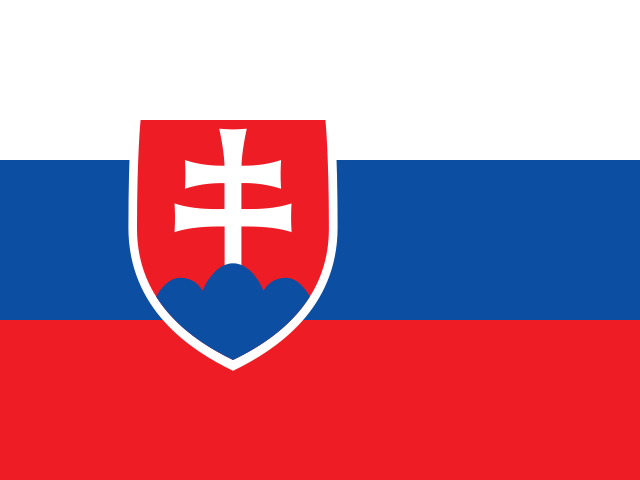 Slovakia
The demand for truck drivers in Slovakia in 2026
Slovakia is one of Central Europe's busiest logistics hubs. It sits directly on major trade crossroads connecting Western Europe with Eastern Europe and the Balkans. Because of its massive car manufacturing industry and central location, Slovakia suffers from a permanent shortage of commercial heavy vehicle drivers.
If you hold a valid Category C or C+E licence from outside the European Union, your skills are in high demand across Slovak transport fleets. Slovak trucking companies routinely hire drivers from South Asia, Central Asia, Western Africa, Latin America, and the Western Balkans. They need international long-haul drivers as well as regional delivery drivers.
Demand in Slovakia is strong and genuine. You do not need to look elsewhere if you want to drive trucks in Europe. Slovakia offers a straightforward entry point into European logistics, supported by simplified national visa rules designed specifically to fill transport vacancies.
Licences, Code 95, and qualification rules in Slovakia
To drive a heavy truck commercially in Slovakia, having a basic driver licence from your home country is only the first step. You must meet specific EU safety and professional standards before you can operate a vehicle on public roads.
- Category C and C+E licences: You must hold a valid Category C (heavy rigid truck) or C+E (articulated vehicle or truck with heavy trailer) licence. Most international transport companies in Slovakia specifically hire C+E license holders.
- Code 95 qualification: Known locally as the Driver Qualification Card (Kvalifikačná karta vodiča or KKV), this certificate proves you have completed initial or periodic professional driver training. Non-EU drivers must complete Code 95 training at an accredited training center approved by the Ministry of Transport of the Slovak Republic (Ministerstvo dopravy SR). Many Slovak employers will arrange and help pay for your Code 95 training once you arrive.
- Digital tachograph card: You must apply for a Slovak driver tachograph card (Digitálna karta vodiča) to record your driving hours and rest periods. This card is issued by authorized technical inspection bodies under the oversight of national transport authorities.
- Medical and psychological examinations: Slovak law requires every commercial driver to pass a mandatory medical exam (lekárska prehliadka) and a psychological evaluation (psychologické vyšetrenie vodičov). These check your reaction speeds, stress resilience, and physical fitness.
- Language requirements: You do not need to speak fluent Slovak to drive international routes (Medzinárodná kamiónová doprava - MKD). Most dispatchers communicate in English, Russian, or German. However, learning basic Slovak phrases helps when dealing with local warehouses, mechanics, and border officials.
Key logistics hubs and regions hiring drivers
Trucking operations in Slovakia are concentrated around major industrial parks and highway intersections. When searching for work or listing your location preferences, keep these main regions in mind:
- Senec and the Bratislava Region: Senec is the absolute heart of Slovakia's logistics sector. Parks like Prologis Park Senec house dozens of international logistics firms, freight forwarders, and retail distribution centres. This region offers the highest volume of long-distance European routes.
- Trnava and Nitra: These regions are heavy industrial and automotive hubs. Large assembly plants, such as Stellantis in Trnava and Jaguar Land Rover in Nitra, rely on complex supply chains. Transport fleets here hire drivers for both regional shuttle routes and international transport of auto parts across Germany, France, and Belgium.
- Žilina and Martin: Located in northern Slovakia along the main corridor to Poland and the Czech Republic, Žilina is a major rail and road transit hub. It is home to Kia Motors and numerous bulk transport companies specializing in mountainous and trans-European freight.
- Košice and Prešov: Located in Eastern Slovakia, these cities serve as key logistics gateways toward Ukraine, Hungary, and Poland. Drivers here handle significant cross-border freight traffic.
Work permits, national D visas, and immigration pathways
As a non-EU worker, you cannot simply arrive in Slovakia on a tourist visa and start driving. You must follow the legal immigration process. Slovakia has simplified rules for commercial drivers because the trade is officially recognized on national shortage-occupation lists.
The standard route involves an accelerated National D Visa (Národné vízum) issued for specific target occupations, including heavy truck drivers. The Slovak government frequently issues special decrees allowing transport companies to fast-track non-EU driver applications.
- Job offer and employer registration: A registered Slovak transport company must offer you a contract and report the vacancy to the Central Office of Labour, Social Affairs and Family (ÚPSVaR).
- National D visa application: You apply for a D visa at the Slovak embassy or consulate in your home country or country of legal residence. You must submit your passport, a clean criminal record certificate with apostille or superlegalization, your employment contract, and proof of accommodation provided by the employer.
- Arrival and foreign police registration: Once in Slovakia on your D visa, you submit your application for Temporary Residence for employment (Prechodný pobyt na účel zamestnania) at the local Foreign Police department (Cudzinecká polícia).
- Medical and driver tests: Before you take your first load, your employer will schedule your medical exam, psychological test, and Code 95 course.
Wages, daily allowances, and working conditions
Truck driver pay in Slovakia is split into two separate parts: your basic net base salary and your tax-free daily travel allowances (diéty). Understanding this distinction is essential for calculating your true monthly income.
- Local and regional driving: Local drivers operating within Slovakia return home most nights or weekends. Net monthly pay typically ranges from €1,100 to €1,500 after taxes.
- International long-haul driving (MKD): Long-haul drivers operating across the EU (typically driving routes through Germany, France, Italy, and the Benelux countries) earn significantly more due to daily allowances. Total net monthly earnings for international drivers generally range between €1,800 and €2,600.
- Understanding daily allowances (diéty): Your basic contract wage might be around €800 to €1,000 gross per month. However, for every day you drive outside Slovakia, you receive mandatory tax-free daily allowances ranging from €50 to €85 per day, depending on the country you operate in.
- Hiring seasons: Recruitment happens year-round, but hiring peaks take place in spring (March to May) and autumn (September to November) as transport fleets prepare for industrial shifts and holiday retail surges.
Reality check: Common myths about driving in Slovakia
- Myth: Your home Code 95 is automatically valid in Slovakia. Fact: Non-EU driver qualifications are rarely accepted directly. You must complete a periodic or initial qualification course inside the EU to receive a Slovak Code 95 card.
- Myth: Daily allowances count toward your retirement pension. Fact: Allowances (diéty) are tax-free expenses to cover food and living costs on the road. Only your base salary counts toward social insurance, sick leave, and pension contributions.
- Myth: You must pay an agency to get a work permit. Fact: Employers and reputable fleets handle immigration paperwork directly through official government channels. Workers never pay fees to find employment or register their details.
- Myth: You can drive immediately upon landing in Slovakia. Fact: Legally, you must complete your medical checks, psychological exam, and tachograph card processing before operating a commercial freight vehicle. This onboard process usually takes 2 to 4 weeks after arrival.
Build your Workuro profile to reach Slovak transport fleets
Slovak transport companies actively search for qualified international drivers to fill their trucks. To make it easy for employers to evaluate your background and offer you a position, make sure your Workuro profile is completely filled out with accurate information.
Include specific details that Slovak transport recruiters look for:
- Licence category and issue date: State clearly whether you hold a Category C or C+E licence and how many years of commercial driving experience you have.
- Existing EU documents: Mention if you already possess a European Code 95, a digital tachograph card, or a valid EU residence permit from a previous job.
- Language abilities: List your level of English, Russian, German, or basic Slovak.
- Preferred hub regions: Indicate if you are open to working out of Senec, Bratislava, Trnava, Nitra, or Žilina.
A complete profile with clear qualifications helps Slovak employers find you faster and start the hiring process directly.
Ești gata să fii găsit?
Creează-ți profilul în 2 minute. Gratuit, fără card bancar.
Continuă lectura