Live-in Caregiver (Badante) Jobs in Italy: Contract, Pay, Hours and the Legal Route
 Italy
What a badante is, and why Italy needs so many
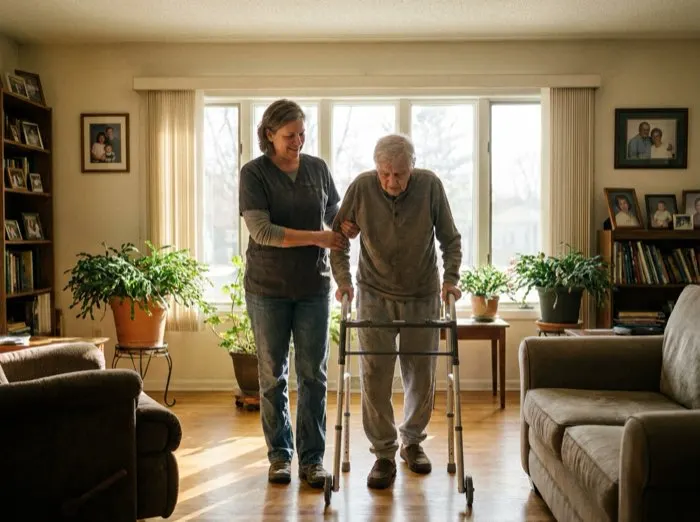
In Italy a badante is a person who looks after an elderly or disabled adult at home. Most badanti live in the home of the person they care for. Italy has one of the oldest populations in Europe, families rarely use care homes, and the state pays a monthly allowance (indennità di accompagnamento) that many families use to employ a caregiver. That is why the demand is large and steady, and why it is the trade with the most legal places for non-EU workers in the Italian quota system.
Most badanti are women, many from Eastern Europe, the Philippines, Peru, Sri Lanka and increasingly from Bangladesh, India and Morocco. Men are hired too, usually for heavier care of bedridden men. The work is physical and emotional: washing, dressing, cooking, medication times, night calls, company. If you have cared for a parent or worked in a hospital or care home, you already know most of it.
The contract: colf and badante under the domestic work agreement
Every badante in Italy is employed under one national collective agreement for domestic work, the CCNL Lavoro Domestico, signed by the employer associations and the unions. The same agreement covers colf (housekeepers) and babysitters. The contract is not optional. A family that pays you cash without a contract is breaking the law, and you have no permit, no pension, no insurance and no proof of work.
- Convivente (live-in): you live in the family's home, with your own room and meals. The standard is 54 hours a week, with a daily rest of 11 hours (of which 8 at night), a half day off plus one full day off a week, usually Sunday. Night presence can be paid separately.
- A ore (hourly, living out): you rent your own room and are paid by the hour. Common in cities and for day care of several families.
- Level: the agreement sets pay by level. A caregiver for a self-sufficient person is usually level B or BS; a caregiver for a non-self-sufficient person (bedridden, dementia) is level CS or DS, which pays more. Ask which level is on your contract before you sign.
The contract must state the level, the hours, the pay, the room and board, and the start date. You keep a copy. The agreement is updated every January; the pay tables are published by the employer associations and are public.
What a live-in badante earns in 2026
These are the ranges families actually pay under the 2026 tables, as of October 2026. Check the current table before you accept anything, because the figures move every year.
- Level BS live-in (self-sufficient person): roughly 1,050 to 1,200 euro net a month, plus room and board.
- Level CS live-in (non-self-sufficient person): roughly 1,150 to 1,350 euro net a month, plus room and board.
- Level DS live-in (trained caregiver, qualified): roughly 1,300 to 1,500 euro net a month.
- 13th month (tredicesima): one extra monthly pay in December, by law.
- TFR (severance): about one month's pay for each year worked, paid when the job ends.
- Paid holiday: 26 working days a year.
Because room and board are included, a live-in badante who sends money home usually keeps far more of the pay than a factory worker renting a room in Milan. Northern cities pay at the top of each range, the south at the bottom.
What the family must do: INPS, contributions, pay slip
The family is your employer. By law the family must register your contract with INPS, the national social security institute, within the day before you start. INPS then sends quarterly contribution bills to the family. These contributions pay for your pension, your sick pay, your maternity and your unemployment later. You should receive a monthly pay slip (busta paga) and, every year, the CU tax certificate.
If a family tells you "we will register you later" or "it is cheaper for both of us without INPS", understand what you lose: no legal stay, no pension years, no proof of income for a permit renewal, and no protection if you are hurt at work. Many families are honest; some are not. The registration is the test.
The legal route in: the caregiver quota inside Decreto Flussi
You cannot come to Italy on a tourist visa and then become a badante. Converting a tourist entry into a work permit is not allowed, and a family that promises it is either mistaken or lying. The legal route for a non-EU caregiver abroad is the annual quota decree, the Decreto Flussi. For 2026 to 2028 Italy adopted a three-year decree, and it contains a separate quota line for family care and domestic assistance workers, created because the demand from families was so large that the general quota filled in minutes.
The process is the same as for every other trade:
- The family (or a care agency acting as employer) files a request for a nulla osta on your name through the Sportello Unico per l'Immigrazione portal on the published click day.
- If the request is inside the quota, the prefettura checks the family can afford the contract and issues the nulla osta, usually some months later.
- With the nulla osta you apply at the Italian consulate in your country for a national work visa (type D).
- Within eight days of arriving in Italy you sign the stay contract at the Sportello Unico and apply for your residence permit (permesso di soggiorno).
Read the full procedure and the 2026 dates in our pages on the Decreto Flussi and on the Italy work visa. Official detail is on interno.gov.it and integrazionemigranti.gov.it.
Who hires, and how a family finds you from abroad
Families almost never hire a stranger from abroad on their own. In practice there are three paths. A relative or friend already working in Italy introduces you to a family, and the family files the nulla osta on your name. A licensed agency for domestic work (agenzia per il lavoro, authorised by the Ministry of Labour) recruits abroad and places you, and the agency may not charge you a fee under Italian law. Or a family finds your profile directly and writes to you; that is what the Workuro register is for. In every case the person who files must be the employer, and you must have the documents ready before click day: passport valid for at least a year, a clean criminal record certificate, and any care training certificates, translated.
Reality check: what people get wrong
- "I will go as a tourist and find a family." It is illegal and you will have no permit. Families know it and the serious ones will not hire you.
- "The agency wants 3,000 euro for the nulla osta." A nulla osta costs the employer a 16 euro stamp. Nobody may charge you for it. Pay nothing to anyone for a permit, a quota place or a click-day slot.
- "Live-in means I am always on duty." The agreement gives you 11 hours of daily rest and 36 hours off a week. If a family ignores this, the local union (CGIL, CISL, UIL have domestic work desks) will help you, free.
- "I need perfect Italian." You need enough Italian to understand medication, the doctor and the family. Basic Italian (A1 to A2) is enough to start; it improves fast when you live in an Italian home.
- "The quota is open all year." It is not. It is one click day, and the places go in minutes. Everything must be ready before.
Where this leaves you
Read these next, in this order:
- Caregiver jobs in Italy for foreign workers
- Italy's Decreto Flussi explained
- Italy work visa 2026: types, cost, processing time
- Working in Italy from Bangladesh: visa, permit, costs
- How to spot and avoid European job and visa scams
Your Workuro profile is free. Employers in Italy search the register and contact you directly, and nobody is ever charged to be listed or found: create a free profile.
Готові, щоб вас знайшли?
Створіть профіль за 2 хвилини. Безкоштовно, без картки.
Читати далі