Roofing Jobs in Europe for Foreign Workers (2026)

 Europe
Roofing is one of the most reliably short-staffed trades in Europe. The workforce is ageing, young locals rarely enter the trade, and the work cannot be automated or done remotely. Add the solar boom - most panels go on roofs - and energy-renovation programmes, and roofers have genuine leverage in the 2026 labour market.
Where the demand is
- Germany: roofers (Dachdecker) appear regularly among shortage occupations; the solar and insulation retrofit wave keeps order books full.
- Austria: roofing has featured on the Red-White-Red Card shortage lists, giving qualified roofers a direct permit path.
- Netherlands and Belgium: steady renovation demand; expect VCA certification requirements.
- Nordics: good pay for roofers comfortable with steel roofing and winter conditions; site cards (ID06 in Sweden, HSE card in Norway, Valtti in Finland) are mandatory.
- France and Ireland: housing programmes drive demand for both tile and flat-roof specialists.
Skills and certificates that matter
Roofing splits into families - pitched tile and slate, metal roofing, flat roofs (bitumen, EPDM, PVC) and increasingly solar mounting. Employers pay a premium for workers who can show:
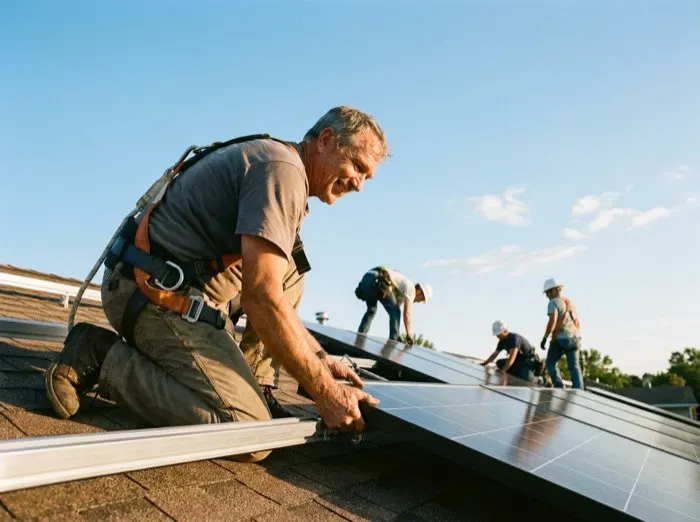
- Working-at-height training and harness competence - mandatory in some form everywhere
- Hot-work certification for torch-applied bitumen (a formal card in the Nordics)
- Manufacturer training for membrane systems or solar mounting
- National vocational qualifications - a German Geselle certificate or equivalent is powerful for permit applications, since routes like Germany's Skilled Immigration Act require recognised training
Pay: hedged ranges by region
As a rough 2026 guide: in Germany, Austria, the Netherlands and Belgium, experienced roofers typically earn around 17 to 24 euros gross per hour, with flat-roof and solar specialists at the top. In Scandinavia the equivalent is often 20 to 27 euros, offset by higher living costs. Southern Europe pays less - roughly 1,300 to 1,900 euros gross monthly in Spain or Portugal - but demand there is rising with EU renovation funding. Piece-rate roofing crews can out-earn hourly workers substantially, but check insurance and social contributions before accepting piece-rate arrangements.
Permits: how roofers get in
EU citizens move freely. For non-EU roofers, the strongest cards are a documented vocational qualification plus years of provable experience - these unlock skilled-worker routes in Germany and Austria in particular. Some come via posted-worker arrangements with Eastern European employers; if so, insist on the host country's pay rates and an A1 certificate. Our guide on how EU employer sponsorship works covers the employer's side of the process. And a hard rule: no legitimate employer or agent charges you for a job offer.
The honest downsides
Roofing is weather-exposed, physically hard and statistically one of construction's most dangerous trades - falls remain the top killer on European sites. Take the height training seriously, refuse unsafe roofs, and prefer employers who supply proper edge protection over those who hand you only a harness.
Seasonality and how to plan a roofing year
Roofing is seasonal almost everywhere: the strong months run from March to November in Central Europe, with winter bringing repairs, emergency work and interior-adjacent tasks rather than full production. Good employers smooth this with winter schemes - Germany's seasonal short-time money, Austria's BUAK arrangements, Nordic indoor rotation - so ask directly how the firm handles January before you sign for April. Solar installation is changing the rhythm too: mounting crews work later into the cold season, and roofers who cross-train into panel mounting and flashing details around installations report fuller calendars than pure tile crews.
Getting in without a full national qualification
Not every roofer arrives with a certificate. A realistic ladder exists: start as a roofer's helper or in flat-roof crews where systems training is given on the job, collect the host country's height and hot-work cards quickly, then push for manufacturer trainings - membrane and solar-mounting certificates are short, cheap and immediately visible to employers. Document everything with photos of completed roofs and dated references; roofing hiring is portfolio-driven more than most trades. Check your insurance position explicitly: you want confirmation of employer liability and accident insurance in writing, because informal roofing work concentrates precisely where the fall risk is worst. A final practical note - buy your own quality harness and hard-toe boots even when the employer provides gear; owning fitted personal equipment marks you as serious and travels with you between contracts.
This is general information, not legal advice. For permits, check the immigration authority of your target country or the EU's official job mobility portal, eures.europa.eu.
Roofing employers across Europe search for workers with height training and system experience. Create your free profile - free, no credit card - and let employers contact you directly.
Готові, щоб вас знайшли?
Створіть профіль за 2 хвилини. Безкоштовно, без картки.
Читати далі