Solar Installer Jobs in Europe for Foreign Workers (2026)
Solar is the trade route into Europe that barely existed fifteen years ago. The EU is installing tens of gigawatts of photovoltaics a year, and the industry keeps warning that panels are easier to source than people. For foreign workers the sector has a specific advantage: much of the work is trainable on the job, while the certified-electrician layer on top is chronically short.
Two jobs, two profiles
Solar teams are usually split:
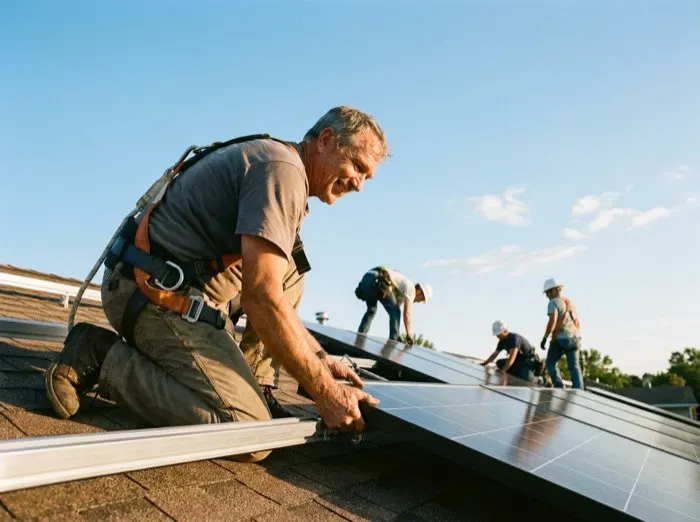
- Mounters / PV assemblers - racking, panel placement, roof or ground-mount mechanics. Employers train motivated workers with construction basics; roofing experience, working-at-height comfort and physical stamina matter most. Lower pay, easier entry.
- Solar electricians - DC/AC wiring, inverters, grid connection, commissioning. This layer requires a qualified electrician, often with country-specific authorisation to sign off connections, and it is where the real shortage and the better pay sit.
Where the work is
| Market | Character |
|---|---|
| Spain | Europe's utility-scale leader; big projects in Extremadura, Andalusia, Aragon; crews travel between sites |
| Germany | Huge rooftop and commercial market; certified electricians needed for grid connection sign-off |
| Netherlands | Dense rooftop market plus commercial; grid congestion makes qualified connection staff valuable |
| Poland | Fast-grown rooftop market; entry wages lower but permits comparatively quick |
| Portugal, Greece, Italy | Strong utility-scale pipelines; project-based contractor work |
Certifications that help
- A recognised electrician qualification from home, ideally with documentation ready for recognition procedures (see our country guides, for example Germany);
- Working-at-height and scaffolding/rooftop safety training;
- Country schemes for renewables installers (such as RESCERT in Belgium) and manufacturer inverter certifications - often arranged by employers, valuable on your CV afterwards;
- A driving licence: solar crews move constantly.
Pay: hedged and honest
Ranges vary enormously by country. As a rough 2026 guide: mounters typically earn from around 1,200 to 1,500 euros gross monthly in Iberia and Poland up to roughly 2,500 to 3,200 euros in Germany and the Netherlands; qualified solar electricians typically earn around 20 to 40 percent more than mounters in the same market, and commissioning technicians more still. Utility-scale projects often add travel and accommodation allowances - always ask exactly what is covered.
The permit reality
There is no EU-wide 'solar visa'. Each country's normal work-permit rules apply, and mounter roles - being lower-paid and lower-qualified on paper - can be the hardest to sponsor, while qualified electricians clear thresholds more easily. Read EU work permits and visas explained for the fundamentals. Be especially careful in this sector about posted-work chains and subcontractors: insist on a written contract, know who your legal employer is, and remember that nobody legitimate charges workers for a job offer.
Choosing your market strategically
Because the trade-off between wages, permits and language differs sharply, match the market to your profile:
- Certified electrician with documentation ready: Germany or the Netherlands - the recognition effort is repaid by the highest solar-electrician wages and permanent demand for connection-qualified staff;
- Experienced but lightly certified: Spain or Portugal - utility-scale contractors value proven site experience, Spanish or Portuguese language opens doors, and crews are built around a few certificate-holders;
- Building experience from a construction background: Poland's rooftop market or Iberian mega-projects offer the fastest entry, with permits that move quickly;
- Long-term career angle: operations and maintenance (O&M) roles on completed solar parks are year-round, less nomadic and increasingly short-staffed as fleets grow - a natural second step after two seasons of installation.
Questions to ask before signing
Solar's project rhythm creates specific risks, so get answers in writing: Who is my legal employer - the main contractor or a subcontractor? What happens between projects - paid standby, or gaps without income? Are travel days, accommodation and meals covered, and at what rates? What safety training is provided before I am on a roof or in a field? A serious contractor answers all four without hesitation, in writing, before you commit to travel or resign from anything at home. And treat any demand for an upfront 'placement' or 'equipment deposit' payment as the red flag it is.
This is general information, not legal advice. Check the immigration authority of your target country and eures.europa.eu for current rules.
Solar contractors staff up in waves and search actively for available crews. Create your free profile on Workuro - free, no credit card, and employers contact you directly.
Ready to be found?
Create your profile in 2 minutes. Free, no credit card.
Keep reading