Scaffolder Jobs in Greece for Foreign Workers (2026)
 Greece
Scaffolding Jobs in Greece: What You Need to Know First
Greece is experiencing a steady recovery in building, green energy projects, and coastal development. However, we should be honest with you right from the start. If your primary goal in coming to Europe is to make the highest possible monthly salary as a scaffolder, Greece is probably not your best target. Countries like Germany, the Netherlands, or Belgium pay higher net wages for scaffolders.
Where Greece excels is in steady, long-term employment across maritime shipyards, major city developments, and massive seasonal hotel renovations. If you come from a non-EU country in South Asia, Africa, Latin America, Central Asia, or the Western Balkans, Greece offers a clear legal path to enter Europe through work sponsorship. Demand for physical trades is real because many young Greeks have moved abroad or chosen office careers.
To work here legally, you need an employer who will sponsor your entry before you leave your home country. You cannot arrive as a tourist and convert your status later. In this guide, we break down exactly where the work is, how much money you will take home, and what steps you need to take to get hired.
Where the Scaffolding Work Is in Greece
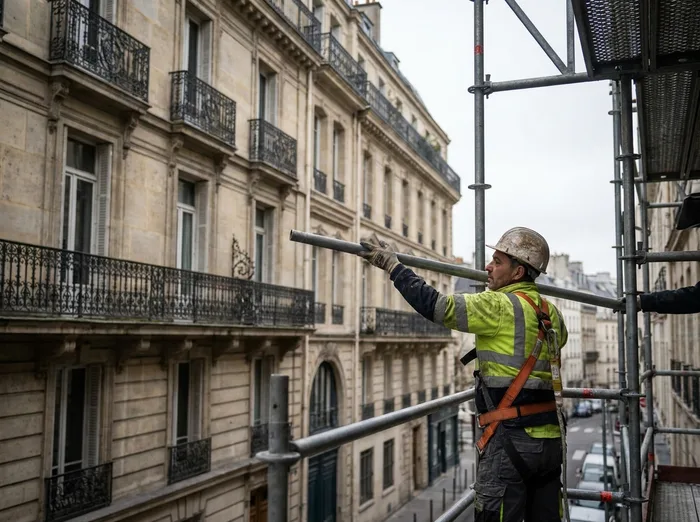
Scaffolding work in Greece is concentrated in specific industrial hubs, major cities, and tourist regions. You will not find equal demand across the entire country. The heavy work sits in four main areas:
- Perama and Piraeus Shipyards: Located near Athens, this is one of the busiest maritime repair zones in the Eastern Mediterranean. Scaffolding crews here build complex tube-and-coupler systems around ship hulls, dry docks, and marine engines. The work requires high skill and pays better than standard building sites.
- Greater Athens and Attica: The capital is undergoing major urban renewal. The Ellinikon project - a massive redevelopment of the old airport site - requires hundreds of scaffolders for commercial towers, residential blocks, and infrastructure. Standard modular scaffolding (like Layher or Ringlock) is common here.
- Thessaloniki and Northern Industrial Zones: Greece second city has active port expansion projects, logistics centers, and industrial plant maintenance. Scaffolders are needed year-round for commercial building and factory upgrades.
- Island Resort Zones (Crete, Rhodes, Mykonos, Corfu): Tourism drives a strict construction cycle. Hotels and luxury resorts undergo heavy structural maintenance, facade painting, and expansion between November and April when tourists are gone.
Pay, Hours, and Working Conditions
Pay in Greece is calculated on a monthly net basis (the cash that lands in your bank account after income tax and national insurance contributions). Your earnings depend heavily on whether you work in standard building construction or specialized industrial sites.
- General Construction Scaffolders: Expect a net monthly pay between 850 EUR and 1,100 EUR for a standard 40-hour work week.
- Shipyard and Heavy Industrial Scaffolders: Skilled scaffolders working in Perama or heavy industrial plants can earn between 1,100 EUR and 1,500 EUR net per month due to danger pay and specialized skill requirements.
- Overtime and Roster: A normal work week is 5 days, 8 hours per day (usually 07:00 to 15:00 to avoid late afternoon heat). Overtime is common during high-demand periods and is paid at 20 percent to 40 percent above the base hourly rate.
- Accommodation Support: On island hotel projects, employers almost always provide free shared accommodation and sometimes meals. On long-term urban projects in Athens or Thessaloniki, you usually pay for your own room, which costs around 250 EUR to 400 EUR per month in shared housing.
- Weather and Seasonality: Greece experiences severe summer heatwaves in July and August. By law, outdoor physical work stops during extreme heat advisories (over 40 degrees Celsius) during mid-day hours.
Visas, Work Permits, and Safety Certificates
To work as a scaffolder in Greece as a non-EU citizen, you must follow the official government hiring channel known as the Metaklisi system. Every two years, the Greek government publishes a regional quota list outlining how many foreign workers each region can import for specific trades.
Here is the exact procedure to get your paperwork sorted:
- Employer Approval: A registered Greek construction company submits an application to their local Decentralized Administration showing they cannot find a Greek or EU worker for the job.
- Type D National Visa: Once approved, the government issues an authorization. You present this to the Greek Embassy or Consulate in your home country to receive a Type D National Visa for employment.
- Residence Permit (Adia Diamonis): After you land in Greece, your employer helps you register for an electronic residence permit (Adia Diamonis) for initial employment, along with an AMKA (social security number) and AFM (tax identification number).
- Health and Safety Certification: Safety regulations on Greek worksites are governed by the Hellenic Institute for Occupational Health and Safety (ELINYAE). While Greece does not require a complex national scaffolder card system like Britain CISRS, high-value sites (like shipyards or large commercial builds) require a site safety induction certificate and proof of medical fitness for working at heights.
- Diploma Recognition: If you hold formal scaffolding qualifications from your home country, you can submit them to EOPPEP (the National Organisation for the Certification of Qualifications and Vocational Guidance) for official verification. However, most employers value verified practical experience over paper diplomas.
Reality Check: Common Mistakes Foreign Workers Make
- Mistake 1: Arriving on a tourist visa hoping to find a job. You cannot change a tourist visa into a legal work permit inside Greece. You will be forced to leave, and working illegally risks deportation and a ban from the Schengen area.
- Mistake 2: Expecting Northern European wage levels. Pay in Greece is lower than in Western Europe. Calculate your potential earnings against local living costs before deciding to relocate.
- Mistake 3: Underestimating physical conditions in summer. Scaffolding in 38-degree heat carrying heavy steel tubes is extremely demanding. Physical endurance and strict hydration habits are essential.
- Mistake 4: Expecting every foreman to speak English. While engineers and project managers speak English, daily foremen on local residential sites often communicate only in Greek. Learning basic Greek work terms is necessary for site safety.
- Mistake 5: Overlooking seasonal work stops. Resort projects end abruptly in April when tourist season begins. Make sure your employment contract covers a full 12-month period or clearly outlines your next placement.
Worksite Culture and Language on Greek Sites
Greek construction sites operate on fast communication and direct instructions. Foremen expect you to work hard, follow instructions immediately, and keep the staging areas organized. Safety culture has improved significantly in recent years due to strict labor inspectorate audits (SEPE), meaning safety harnesses, hard hats, and steel-toe boots are strictly enforced on all major projects.
English is widely used in international marine projects and mega-developments like Ellinikon. However, on smaller construction sites, Greek is the main language. Learning trade vocabulary right away - such as words for clamps (sfigktiras), pipes (solina), platforms (dapedo), and harness (zoni asfaleias) - will make your work safer and win you respect from your crew leaders.
Build Your Workuro Profile to Get Hired in Greece
Greek employers searching for foreign scaffolders use Workuro to find workers who are ready to relocate. To make sure your profile appears when a company in Athens, Piraeus, or Thessaloniki is searching for tradesmen, fill in these specific details:
- List Your Specific Systems: State clearly which scaffolding systems you can build, such as Layher Allround, Cuplok, Kwikstage, or traditional tube-and-fitting systems.
- Highlight Marine or Industrial Experience: If you have worked in shipyards, oil refineries, or high-rise building projects, state this clearly in your employment history.
- Include Heights and Safety Cards: Mention any working-at-heights safety training, rope access cards (like IRATA), or plant operator tickets you hold.
- Select Specific Greek Regions: Indicate that you are willing to work in Attica (Athens), Piraeus, Thessaloniki, or the Greek Islands.
- State Your Language Capabilities: List your English level and any basic Greek or European languages you know.
A complete profile with clear job history photos and detailed system experience gives Greek hiring managers the confidence to sponsor your entry visa under the official quota system.
Ready to be found?
Create your profile in 2 minutes. Free, no credit card.
Keep reading