Painter and Decorator Jobs in France for Foreign Workers (2026)
 France
Demand for Painters in France and Where the Work Is
If you are a painter and decorator from outside the European Union, France has steady work for you. The French building and renovation sector, known as BTP (Bâtiment et Travaux Publics), faces a constant shortage of skilled finishing workers. French property owners heavily value interior and exterior maintenance, and the country renovates hundreds of thousands of residential units every year. You do not need to worry about whether France hires foreign painters. The demand is real and widespread across the country.
Where you move in France depends on what type of painting you do best. Key areas hiring painters include:
- Île-de-France (Paris Region): This is the largest construction market in the country. Commercial renovations, public housing updates, and high-density apartment blocks need painters year-round. Pay tends to be higher here to balance local living costs.
- Auvergne-Rhône-Alpes (Lyon, Grenoble, Annecy): A strong economic hub with rapid housing growth and historic building updates. Commercial and residential projects are active throughout the year.
- Provence-Alpes-Côte d'Azur (Marseille, Nice, Toulon): High demand for villa repainting, hotel refreshes, and exterior facade work. The sunny coastal climate means outdoor painting runs longer into the winter than in the north.
- Nouvelle-Aquitaine (Bordeaux, La Rochelle): Rapid urban growth and historic home renovations create regular openings for residential painters and plaster finishers.
The hiring cycle in France peaks between March and November for exterior work, such as facade coating and painting (ravalement de façade). Interior painting, wall covering, and surface preparation continue steadily through the winter months.
Qualifications and Recognized Trade Standards in France
French trade standards are structured around formal qualifications. Employers in France look closely at what you know how to do, especially preparation work. In France, a painter is rarely just someone who applies paint with a roller. You are expected to prepare surfaces to a smooth standard before opening a tin of paint.
The standard certificates and qualifications in France include:
- CAP Peintre-applicateur: The core French vocational diploma for painting. It proves you understand surface preparation, wall coverings, and paint application.
- Titre Professionnel Peintre en bâtiment: A professional qualification issued by the French Ministry of Labor through recognized training organizations like AFPA. Employers respect this credential deeply.
- ENIC-NARIC Recognition: If you hold a diploma or trade certificate from your home country in South Asia, Africa, Latin America, the Balkans, or Central Asia, you can apply online to ENIC-NARIC France for a statement of comparability (attestation de comparabilité). This proves to a French employer that your qualification matches French standards.
- CACES and Safety Cards: To work safely on scaffolding or motorized lift platforms, you may need a CACES license (Certificat d'Aptitude à la Conduite En Sécurité), specifically category R486. If you have experience operating scissor lifts or cherry pickers, state it clearly.
Work Permits and Shortage Occupation Rules for Non-EU Workers
To work legally in France as a citizen of a non-EU country, your employer must secure a work permit for you before you travel. You cannot arrive on a tourist visa and start working. The process is clear, and French law allows employers to hire non-EU talent when local labor is scarce.
Here is how the work permit and visa route works step by step:
- Shortage Occupation List (Métiers en tension): The trade of peintre en bâtiment is included on regional shortage lists across many departments in France. When a job is on this list, the employer does not need to show proof that they tried to recruit a French or EU citizen first. This speeds up your application significantly.
- Online Permit Application: Your employer submits your job offer to the online ANEF portal (Administration Numérique pour les Étrangers en France). The labor ministry reviews your employment contract, wage offer, and trade background.
- Visa Issuance: Once the work permit approval (autorisation de travail) is granted, you apply at the French consulate in your home country for a long-stay work visa (VLS-TS - Visa de Long Séjour valant Titre de Séjour).
- Processing Time: The total time from receiving a formal job offer to visa approval usually takes between 8 and 14 weeks, depending on consulate processing times in your region.
Pay Rates, Net Salaries, and Collective Bargaining
Pay in the French construction sector is regulated strictly by collective bargaining agreements (Convention collective nationale du bâtiment). These rules protect workers by setting national wage floors, mandatory breaks, safety allowances, and overtime rates.
Here is what you can realistically expect regarding earnings in France:
- Baseline Minimum Wage: No legal employer in France can pay less than the SMIC (Salaire Minimum Interprofessionnel de Croissance). As of 2026, the SMIC baseline delivers a net salary of roughly 1,400 Euros per month for a standard 35-hour work week.
- Starting Net Pay for Qualified Painters: An entry to mid-level foreign painter typically earns between 1,550 Euros and 1,850 Euros net per month after taxes and social security contributions.
- Experienced Decorators and Team Leaders: If you specialize in decorative finishes, airless spray systems, or lead a team (chef d'équipe), net pay ranges from 1,900 Euros to 2,300 Euros per month.
- Daily Allowances (Paniers et Transport): Construction workers in France receive tax-free daily allowances under the BTP collective agreement. These include a daily meal allowance (prime de panier) of roughly 10 to 14 Euros per work day, plus a travel allowance based on the distance to the job site.
Language Requirements and Worksite Culture
You do not need to speak perfect French on your first day, but you cannot work safely on a French site with zero French. Worksite safety signs, client instructions, product mixing ratios, and safety data sheets are all written in French.
Key practical expectations on site include:
- Language Level: A practical A2 level of spoken French is usually the minimum needed for site safety and day-to-day work. If you understand basic instructions and trade terms, many employers will gladly give you a chance.
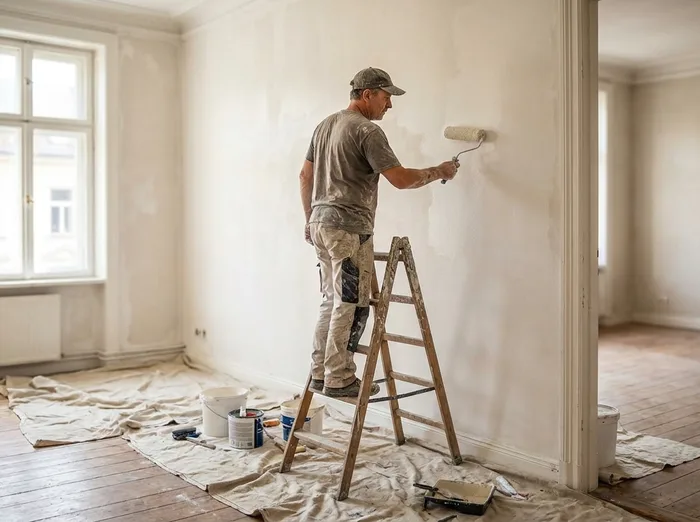
- Plastering and Preparation (Enduisage): In France, painters spend up to 60 percent of their time applying joint compound, smoothing plaster (enduit de lissage), and sanding walls. If you only know how to roll paint, you must be ready to learn plaster prep quickly.
- Modern Tools: French construction companies rely heavily on dustless sanding machines and airless paint sprayers (pistolet airless). Experience with these machines makes your application stand out immediately.
Reality Check: What Workers Get Wrong About France
Many foreign workers arrive with wrong assumptions that slow down their job search. Here is what you need to keep in mind:
- Assuming any client can sponsor a visa: Private homeowners cannot sponsor your work permit. Only registered French companies (like a SARL or SAS) with an official business registration number (SIRET) can sponsor foreign workers.
- Thinking decorative painting is the main market: High-end decorative murals are a small niche market. The vast majority of hired workers handle standard surface filling, drywall jointing, sanding, and emulsion painting.
- Underestimating winter weather outdoors: Exterior facade painting slows down during wet winter months in Northern France. Employers switch teams to interior site renovations during this period.
- Skipping mandatory safety equipment: Working without safety boots, dust masks, or harness equipment is illegal in France. French firms enforce strict safety regulations (EPI - Équipements de Protection Individuelle).
Put Your Specifics into Your Workuro Profile
To help French employers find you quickly, your Workuro profile must showcase exact trade details rather than general statements. Employers search the registry using specific terms, tools, and region preferences.
Make sure you include these details in your profile:
- Trade Title: List your title using French terms like Peintre en bâtiment or Peintre-applicateur alongside your English title.
- Specific Skills: Mention if you excel at plastering and filling (enduisage), airless spray painting, wallpaper hanging (pose de papier peint), or external wall insulation (ITE - Isolation Thermique par l'Extérieur).
- Target Regions: Select the specific French regions where you want to work, such as Île-de-France, Auvergne-Rhône-Alpes, or Provence-Alpes-Côte d'Azur.
- Certificates and Permits: Upload or list any trade diplomas, ENIC-NARIC comparability statements, or safety permits like scaffolding cards.
- Language Level: State your current French language level accurately, whether it is A1, A2, or B1.
Complete profiles with specific trade skills and location choices appear higher in employer searches. Keep your details updated so French companies can reach out to you directly.
Chcesz dać się znaleźć pracodawcom?
Stwórz profil w 2 minuty. Za darmo, bez karty.
Czytaj dalej