Warehouse Jobs in Finland for Foreign Workers (2026)
Where Warehouse Jobs Are Located in Finland
Finland has a steady demand for warehouse and logistics workers, but the jobs are concentrated in specific regions. If you are applying from outside the European Union, you need to focus your job search on the key logistics hubs where large distribution centers operate. Applying to small rural towns will rarely yield a job offer that supports a visa application.
The largest hub for warehouse operations is the Capital Region around Helsinki. Specifically, the city of Vantaa is the center of Finnish logistics. Industrial zones like Viinikkala, Aviapolis, and Hakkila house massive freight terminals and retail distribution hubs. Nearby Sipoo contains major fulfillment centers, including the giant Inex Partners distribution site that handles goods for national supermarket chains. Järvenpää and Kerava, located just north of Helsinki along the main railway line, also host major logistics parks for consumer goods and hardware lines.
Outside the capital area, regional logistics hubs operate in Tampere, Turku, and Kotka. Tampere and its neighbor Pirkkala host central warehouses serving central and northern Finland. Turku and nearby Lieto focus on maritime logistics and trade with Sweden. Kotka and Hamina are port cities with high volumes of heavy cargo, industrial logistics, and timber product handling. If you want to work in Finland, target employers operating in these specific municipalities.
Key Licences and Certificates You Need
Finnish logistics employers value formal safety certifications. Having recognized safety credentials makes your application stand out and shows you are ready to start work immediately without lengthy onboarding. In Finland, three main certificates apply to warehouse environments:
- Occupational Safety Card (Työturvallisuuskortti): Issued by the Finnish Centre for Occupational Safety (Työturvallisuuskeskus - TTK). This green card proves you have completed standardized safety training. Most large warehouses and industrial sites require all workers on site to hold a valid card before entering the floor.
- Hygiene Passport (Hygieniapassi): Issued under the oversight of the Finnish Food Authority (Ruokavirasto). If your warehouse job involves handling unpacked food, cold storage, or grocery fulfillment, you must hold this passport by law. You get it by passing a short written test on basic food safety rules.
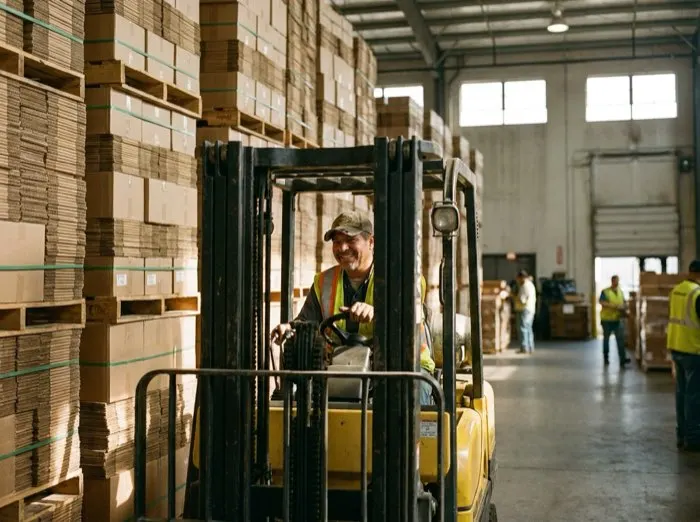
- Forklift Driver Certificate (Trukkikortti): In Finland, there is no single government-issued forklift licence, but employers require documented operator training. Having official proof or practical certificates for operating reach trucks (työntömastotrukki), counterbalance forklifts (vastapainotrukki), or high-level order pickers (keräilytrukki) is a massive asset.
If you already hold European equivalent safety credentials or have documented forklift hours in your home country, highlight them clearly. Employers will still require you to complete the local Finnish safety test, but prior experience helps immensely during hiring.
Work Permits and Labor Market Testing
To work legally in a Finnish warehouse as a non-EU citizen, you need a Residence Permit for an Employed Person (Työntekijän oleskelulupa). The application process involves two distinct authorities: the Finnish Immigration Service (Migri) and the regional Employment and Economic Development Office (TE-palvelut).
Logistics and warehouse roles in Finland are subject to labor market testing, known locally as availability assessment (saatavuusharkinta). Before an employer can sponsor your permit, the TE Office checks whether there are suitable job seekers already residing in Finland or the European Economic Area (EEA) to fill the open position. Because of this rule, securing a sponsorship for a basic entry-level packing job can take time, unless the position requires specialized shift patterns, heavy machinery operator skills, or seasonal surge capacity.
The visa process follows standard steps once you secure a job contract:
- Job offer: The Finnish employer offers you a formal employment contract meeting national labor standards.
- Employer submission: The employer fills out the terms of employment in the online Migri portal (Enter Finland for Employers).
- Applicant submission: You submit your residence permit application online and present your passport at a Finnish embassy or VFS Global center in your home country.
- TE Office decision: The TE Office conducts the labor market evaluation.
- Migri final decision: Upon approval by the TE Office, Migri issues your residence card. The entire process generally takes between two and four months.
Pay, Collective Agreements, and Shift Bonuses
Pay rates in Finland are not decided arbitrarily by individual managers. Instead, wage minimums are governed by legally binding nationwide collective bargaining agreements (työehtosopimus or TES). For warehouse and logistics workers, two main agreements apply: the Commercial Sector Agreement (Kaupan alan TES), negotiated by the Service Union United (PAM), and the Logistics Sector Agreement (Logistiikka-alan TES), negotiated by the Transport Workers' Union (AKT).
Under these agreements, hourly base wages for entry-level warehouse staff range from 11.50 EUR to 14.50 EUR per hour gross, depending on your experience tier and the location of the job. Wages in the Helsinki region are slightly higher to account for regional living costs.
A significant portion of your total pay in Finnish logistics comes from evening, night, and weekend shift differentials:
- Evening shift bonus (iltalisä): Adds roughly 1.50 EUR to 2.50 EUR per hour for work performed after 18:00.
- Night shift bonus (yölisä): Adds roughly 3.00 EUR to 4.50 EUR per hour for shifts between 22:00 and 06:00.
- Sunday pay (sunnuntaikorvaus): By Finnish labor law, work performed on Sundays or official public holidays pays 100 percent extra (double base pay).
A full-time warehouse worker doing standard 37.5 hours per week earns a gross monthly income between 2,000 EUR and 2,700 EUR, depending on shift arrangements. Finland uses a progressive tax system. A worker earning in this range typically pays an effective tax rate of 12 percent to 18 percent, plus mandatory social security and pension deductions of around 8 to 9 percent. Your typical monthly net pay after all taxes and fees will land between 1,500 EUR and 2,100 EUR net.
Hiring Cycles and Language Expectations
Warehouse hiring in Finland moves in distinct waves throughout the calendar year. Understanding these cycles helps you time your job search effectively.
The largest hiring period occurs in late autumn, running from September through November. Retailers and logistics hubs recruit extra workers for the peak fourth-quarter shopping rush, including Black Friday, Cyber Monday, and the Christmas season. The second major hiring cycle occurs in spring, between March and May, as companies hire seasonal cover for regular full-time staff taking their summer holidays (kesäloma) during June, July, and August.
Regarding language: major multinational logistics parks in Vantaa and Sipoo frequently use English as a working floor language. You can successfully perform picking, packing, and sorting with fluent English. However, safety signs, terminal screens, and team briefings are often in Finnish. Learning basic Finnish (A1 or A2 level) gives you a substantial advantage over other applicants and demonstrates long-term commitment to living in Finland.
Reality Check: What Foreign Workers Get Wrong
- Assuming any job offer guarantees a visa: Low-hour or part-time contracts (under 30 hours per week) rarely satisfy Migri minimum income requirements for a work residence permit. You need a contract meeting national living wage guidelines.
- Ignoring local labor market testing: Employers cannot simply choose an overseas candidate over a qualified local applicant without showing the TE Office that they tried to recruit within Finland and the EU first.
- Underestimating winter logistics conditions: Working in Finnish outdoor loading docks, cold storage hubs, or port terminals during winter means operating in sub-zero temperatures. Proper cold-weather gear is mandatory and safety rules are strictly enforced.
- Expecting cash payments or informal wages: Cash pay in Finnish logistics is non-existent. All wages are paid electronically into a Finnish bank account, and all work is recorded on official tax cards (verokortti).
Put Your Details in Your Workuro Profile
To help European employers find you when they have active labor shortages, build a complete and detailed profile on Workuro. Finnish hiring managers filter candidate registries using very specific criteria.
Make sure you list the exact target cities you are prepared to move to, such as Vantaa, Sipoo, Tampere, or Turku. Clearly list any certifications you possess, including the Occupational Safety Card (Työturvallisuuskortti), Hygiene Passport (Hygieniapassi), or forklift operator experience with specific machinery like reach trucks or order pickers. Clearly state your English language proficiency and any Finnish language study you have completed. Keeping your profile precise and up to date ensures you appear in direct searches when Finnish logistics companies look for candidate profiles.
Pronto para ser encontrado?
Crie seu perfil em 2 minutos. Grátis, sem cartão de crédito.
Continue lendo