Shipyard Worker Jobs in Bulgaria for Foreign Workers (2026)

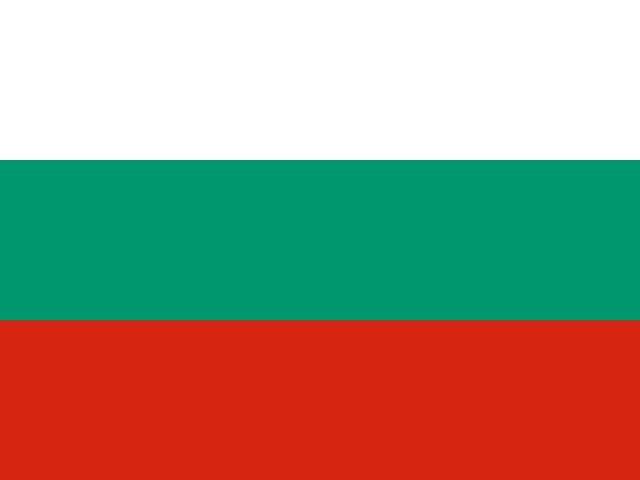 Bulgaria
If you have experience as a welder, ship fitter, pipefitter, or sandblaster, working in a Bulgarian shipyard can be a practical entry point into the European industrial market. Bulgaria is a full member of the European Union, located in Southeast Europe with a long coastline on the Black Sea and a major river border along the Danube. Foreign workers from non-EU countries come here every year to fill trade roles in heavy industry.
Before you start applying, you need an honest picture of what the industry looks like in Bulgaria. Shipyard demand here is specialized and concentrated in just a few locations. Bulgaria does not build massive cruise ships or giant oil tankers like yards in South Korea or Northern Europe. Instead, Bulgarian yards focus heavily on ship repair, vessel conversion, barge construction, and specialized marine fabrication. If you are looking for mega-scale newbuild projects with thousands of workers, neighboring Romania or Croatia may offer larger facilities. However, Bulgaria offers steady work, lower cost of living, and a straightforward work permit process for skilled industrial workers.
Key ports and industrial areas hiring shipyard trades
Shipyard work in Bulgaria is restricted to specific geographic hubs. You will not find these jobs inland, except along the northern border. When you search for opportunities or speak with recruiters, focus on these main locations:
- Varna (Black Sea Coast): Varna is the main center of Bulgaria's maritime industry. Located on the northern Black Sea coast, it houses the country's largest ship repair and shipbuilding facilities. The region handles ocean-going cargo ships, bulk carriers, tankers, and naval vessels. Varna has a deep industrial history and hires the highest number of foreign welders, fitters, and painters.
- Ruse (Danube River): Ruse is Bulgaria's largest river port, located on the Danube river along the border with Romania. The shipyards in Ruse build and repair river barges, pushers, tugboats, and small inland cargo ships. Work here is closely tied to river navigation standards and seasonal water levels.
- Burgas (Southern Black Sea Coast): Burgas is another vital maritime hub. While its facilities are smaller than Varna in terms of new construction, Burgas has active ship repair yards, dockyards, and port infrastructure maintenance crews that regularly need structural steel workers.
Certificates, safety rules, and language skills you need
Bulgarian yards operate under European safety and manufacturing standards. Employers do not expect you to speak fluent Bulgarian on day one, but they strict on technical competence and safety compliance.
- Welding certifications: Welders must hold valid certificates, ideally under the EN ISO 9606-1 standard for steel. Common processes in demand include 135/136 (MAG/Flux-cored wire) for structural hull work and 141 (TIG) for pipework. Certificates issued by international testing bodies like TÜV, DNV, or Bureau Veritas are widely accepted. Local testing is often organized through the Bulgarian Association of Welding (BAZ) upon arrival.
- Fitting and drawing literacy: Ship fitters and hull fabricators must be able to read complex structural drawings and isometric pipe sketches. You should be familiar with metric measurements, plate thickness tolerances, and bevel preparation standards.
- Maritime safety and agency standards: For works involving marine vessels, safety standards are monitored by the Executive Agency 'Maritime Administration' (EA MA - ИА 'Морска администрация'). Workers must complete mandatory shipyard safety orientation covering hot work permits, confined space entry, and working at heights before entering the drydock or slipway.
- Language on the shop floor: Practical English or Russian is commonly used to communicate technical instructions between foreign workers and site supervisors. Learning basic Bulgarian trade terms (like tools, directional commands, and safety warnings) will help you integrate much faster.
Pay rates, working hours, and monthly net income
Bulgaria uses the Bulgarian Lev (BGN), which is officially pegged to the Euro (1 EUR is approximately 1.955 BGN). Wages in Bulgaria are lower than in Western Europe, but basic expenses like housing and food are also significantly lower.
Employers usually quote salaries as a monthly net figure after taxes and social security contributions have been deducted. Here is what skilled non-EU workers can expect to earn on a standard schedule (typically 40 to 48 hours per week):
- TIG and FCAW Welders: Expect a net monthly pay between 2,000 BGN and 3,000 BGN (approx. 1,020 EUR to 1,530 EUR), depending on your test results and experience with heavy plate welding.
- Ship Fitters and Hull Assemblers: Net monthly earnings range from 1,700 BGN to 2,500 BGN (approx. 870 EUR to 1,280 EUR).
- Marine Pipefitters: Net monthly earnings range from 1,800 BGN to 2,600 BGN (approx. 920 EUR to 1,330 EUR).
- Blasters and Industrial Painters: Net monthly earnings range from 1,500 BGN to 2,200 BGN (approx. 760 EUR to 1,120 EUR).
Many Bulgarian employers hiring from abroad provide shared accommodation or offer a monthly housing allowance on top of your base salary. Overtime work is common during active drydock repairs and is paid at higher rates according to the Bulgarian Labour Code.
Seasonality and hiring cycles in Bulgarian yards
Shipyard work in Bulgaria runs throughout the year, but the workload shifts depending on the location and season:
- Black Sea yards (Varna, Burgas): Outdoor assembly and hull grit-blasting peak from April to October when the weather is dry and mild. Ship repair work continues through winter, but cold sea winds can slow down outdoor painting and structural welding.
- Danube river yards (Ruse): River vessel maintenance has a strong seasonal rhythm. Early spring and late autumn are busy as vessel operators prepare fleets before winter icing or summer low-water periods on the river.
Work permits and visa routes for non-EU workers
To work legally in Bulgaria, citizens from non-EU countries need a work permit and a long-stay visa (Visa D). You cannot travel to Bulgaria on a tourist visa and start working. The process is employer-driven, meaning a company in Bulgaria must sponsor you.
- Single Permit for Work and Residence: This is the standard permit for foreign industrial workers. Your employer submits the application package directly to the Bulgarian Employment Agency (Агенция по заетостта) and the Migration Directorate.
- Document requirements: You will need to provide a clean police clearance certificate from your home country, a signed employment contract, proof of accommodation in Bulgaria, and copies of your trade diplomas or welding certificates translated and legalized into Bulgarian.
- Processing time: The approval process generally takes between 8 and 12 weeks. Once the approval is issued in Bulgaria, you apply for your Visa D at the Bulgarian embassy or consulate in your home country before traveling.
Reality check: Common myths about Bulgarian shipyard work
Avoid these frequent mistakes when considering a move to Bulgaria:
- Myth 1: Bulgaria pays Western European wages: Wages in Bulgaria reflect the local economy. While you can save money if your employer provides housing, salaries are lower than in Scandinavia, Germany, or the Netherlands.
- Myth 2: You can change employers freely right away: Your work permit is tied directly to the specific employer who sponsored you. Changing jobs requires a new permit application process.
- Myth 3: English is spoken by everyone on site: While managers often speak English, local foremen and team leaders may speak only Bulgarian or Russian. You must be prepared to learn local work terms quickly.
- Myth 4: Outdoor work is warm all year: Winters in Varna and Ruse can be cold, windy, and wet, with temperatures dropping below freezing. Working on drydocks in January requires proper winter gear.
Build your Workuro profile to reach Bulgarian employers
Bulgarian shipyard employers and international staffing agencies regularly search Workuro to find qualified candidates from abroad. To make sure your profile shows up in their search results, include specific technical details:
- List exact certifications: Mention your specific welding processes (e.g., FCAW 136, TIG 141) and standard codes like EN ISO 9606-1. Mention who issued your certificate.
- Specify your trade skills: Clarify whether you are a hull fitter, pipefitter, structural welder, or surface preparation specialist.
- Target specific regions: Indicate that you are open to working in Bulgarian maritime hubs such as Varna, Ruse, or Burgas.
- Add language abilities: List your English, Russian, or basic Bulgarian proficiency clearly.
Keep your contact details updated and upload clear photos of your official trade certificates. A complete profile gives Bulgarian employers everything they need to extend a job offer and start your visa paperwork.
Готові, щоб вас знайшли?
Створіть профіль за 2 хвилини. Безкоштовно, без картки.
Читати далі