Baker and Pastry Worker Jobs in Austria for Foreign Workers (2026)

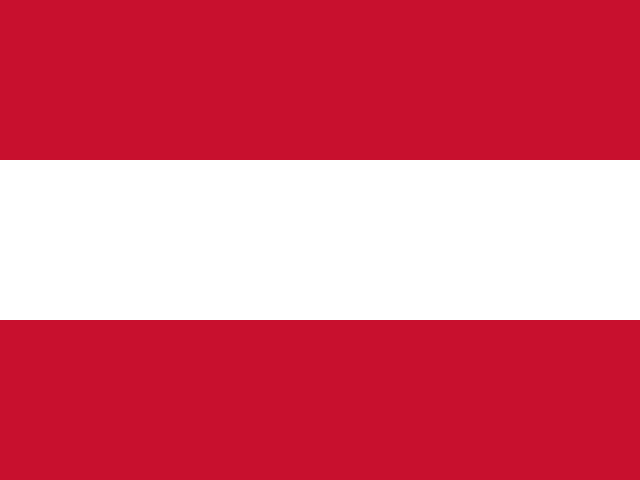 Austria
Austria has a world-famous baking culture. From traditional fresh rolls like the Semmel in the morning to delicate cakes like Sachertorte in the afternoon, baked goods are part of daily life. Because local bakeries and industrial food producers cannot find enough local workers, Austria relies heavily on skilled professionals from outside the European Union. If you come from South Asia, Africa, Latin America, the Balkans, or Central Asia, there is a clear and legal pathway for you to work as a baker or pastry worker in Austria.
Demand for skilled trade workers in this sector is high across the country. Baker (Bäcker) and pastry chef (Konditor) positions regularly appear on Austria's official shortage occupation list. This means Austrian employers actively search for foreign talent, and the government offers a streamlined work permit process to help fill these gaps.
The Red-White-Red Card: Work Permit Route and Timelines
To work legally in Austria as a non-EU citizen, you need a work permit called the Red-White-Red Card (Rot-Weiss-Rot - Karte). Specifically, foreign bakers apply under the category for Skilled Workers in Shortage Occupations.
This permit uses a points-based system. Austria awards you points based on your specific qualifications, years of work experience, age, and language skills in German or English. Because baking is a recognized shortage trade, the threshold of points required is lower than it is for general workers.
- The Application Step: First, you must receive a binding job offer from an employer in Austria. Your employer or you then submit the permit application to the Austrian immigration authority (Magistrat or Bezirkshauptmannschaft) or the Austrian embassy in your home country.
- The Role of the AMS: The Austrian Public Employment Service (Arbeitsmarktservice or AMS) checks your offer. They verify that the employer pays legal wages and that your qualifications match the trade requirement.
- Processing Time: Once you submit a complete file with all translated documents, processing usually takes between 8 and 12 weeks.
- Permit Validity: The initial Red-White-Red Card is valid for 24 months and ties you to your specific employer. After two years, you can convert it into a Red-White-Red Card Plus, which allows you to work for any employer in Austria.
Qualification Recognition and Language Requirements
Austria protects its skilled trades through strict standards. In Austria, local bakers complete a three-year vocational apprenticeship ending in a final exam called the Lehrabschlussprüfung. As a foreign worker, you must prove your training is equivalent.
You must have your official trade diplomas, vocational certificates, and work reference letters translated into German by a certified translator. The Austrian Federal Ministry of Labour and Economy (BMAW) or the Economic Chamber (Wirtschaftskammer Österreich - WKO) assesses your documents to verify equivalence. If you learned your trade purely through uncertified practice, you will find it difficult to qualify for the shortage permit without formal certificates.
Language skills are equally critical:
- German Language Level: For artisanal bakeries and local cake shops (Konditorei), employers usually expect at least an A2 or B1 level in German. Kitchen instructions, safety boards, and recipes are written in German.
- English Language Level: In large industrial baking factories, English is sometimes accepted on the production line, but basic German is still needed for safety protocols and long-term settlement points.
- Food Safety Standards: You must understand HACCP hygiene regulations. Austrian health officers inspect kitchens regularly, so knowledge of food safety rules is a prerequisite during technical interviews.
Salaries, Collective Agreements, and Night Allowances
Pay rates in Austria are not decided randomly by employers. They are governed by strict industry-wide collective bargaining agreements known as a Kollektivvertrag. Every bakery in Austria must pay at least the wage floor set by the national collective agreement for the baking or confectionery trade.
Base monthly pay varies depending on whether you work in an artisanal craft bakery (Bäckergewerbe) or an industrial plant (Brotindustrie):
- Base Gross Salary: A qualified foreign baker typically starts with a base gross monthly salary between €2,100 and €2,700 for a standard 40-hour work week.
- Night Shift Bonuses: Early morning work (often starting between 2:00 AM and 4:00 AM) is standard in this industry. Austrian law mandates generous night shift allowances (Nachtarbeitszuschlag), which can add €300 to €500 extra to your gross monthly paycheck.
- Typical Net Pay: After tax and social security deductions (which cover your complete healthcare, pension, and accident insurance), your monthly net take-home pay ranges from €1,650 to €2,150 net per month, including shift bonuses.
- The 13th and 14th Salary: Austria has a mandatory 14-month pay system. You receive two extra full monthly payments each year: one in June (holiday bonus or Urlaubsgeld) and one in November (Christmas bonus or Weihnachtsgeld). These extra payments are taxed at a much lower rate.
Key Regions, Industrial Areas, and Hiring Cycles
Where you live and work in Austria changes the type of baking job you do and when employers hire. Understanding the geography helps you target the right place at the right time.
- Vienna (Wien): The capital city offers year-round employment in historic pastry shops, modern bakeries, and large hotel kitchens. Hiring happens continuously throughout the year.
- Tyrol, Salzburg, and Vorarlberg: These western alpine regions rely heavily on winter and summer tourism. Luxury hotels and regional bakeries experience massive surges in demand. Hiring spikes happen in October and November for the winter ski season, and in April and May for the summer mountain season. Many resort employers offer free food and staff lodging as part of your contract.
- Upper Austria (Linz and Wels): This region is the heart of Austria's industrial baking sector. Large automated facilities produce packaged bread for supermarkets nationwide. These industrial bakeries hire year-round and often accept workers with lower German levels, provided they have solid machinery experience.
Reality Check: What Overseas Applicants Get Wrong
Many foreign applicants make simple assumptions that lead to rejected applications. Keep these realities in mind:
- Myth: Cake decorating skills are enough.
Reality: Austrian pastry shops prioritize fundamental dough making, lamination, and classic Austrian baking (like puff pastry, yeast doughs, and sponges) over sugar-craft design. - Myth: You can apply without formal papers.
Reality: The Austrian government will not issue a shortage permit based on verbal claims. You must have written proof of training or documented work history on official letterheads. - Myth: You can start work on a tourist visa.
Reality: Working on a tourist visa is strictly illegal in Austria. You must receive your official entry visa (Visa D) or pick up your Red-White-Red Card before you start your first day in the bakery. - Myth: Daytime shifts are guaranteed.
Reality: Traditional Austrian bakeries prepare fresh bread for 6:00 AM shop openings. You must be prepared for early morning or overnight shifts.
Build Your Workuro Profile for Austrian Employers
Austrian bakery owners and human resource managers use Workuro to search for international talent when local vacancies remain open. To ensure your profile matches what Austrian employers search for, make sure you include specific details in your profile details.
Be precise about your experience with equipment like spiral mixers, deck ovens, and dough sheeters. State your exact proficiency in German using European framework levels (A1, A2, or B1) alongside your English level. List your formal certificates, trade diplomas, and food hygiene qualifications clearly. Mention the exact regions in Austria you want to work in, such as Vienna for year-round work or Tyrol for seasonal resort roles. When Austrian bakeries search the registry for qualified candidates, a detailed profile ensures your skills stand out immediately.
Ready to be found?
Create your profile in 2 minutes. Free, no credit card.
Keep reading