Tiler and Floor Layer Jobs in Estonia for Foreign Workers (2026)
 Estonia
1. What tiling and floor laying looks like in Estonia
Estonia is a modern, fast-developing country in Northern Europe. Its construction sector is active, but because the total population is around 1.3 million, the total number of job openings is naturally smaller than in huge European nations. If you are looking for massive volume with thousands of immediate vacancies, nearby Finland is a larger target market. Many Estonian construction firms actually operate as subcontractors across the Nordic region, which means working for an Estonian company can sometimes open doors to regional projects.
Inside Estonia itself, demand for tilers and floor layers is steady. The market focuses heavily on commercial modernisations, new apartment complexes, and public infrastructure. Estonian building standards are high, with strict Nordic codes for moisture barrier systems, insulation, and finish quality. European and non-EU workers from Central Asia, South Asia, Africa, Latin America, and the Western Balkans fill essential roles in these finishing trades.
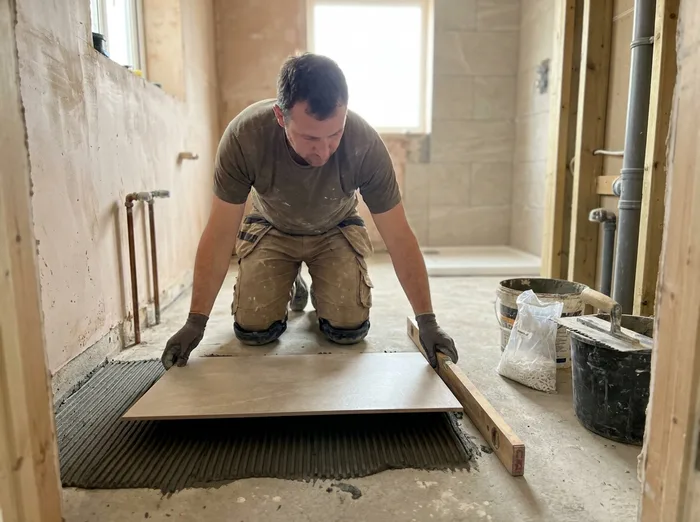
You do not need to worry about complex factory machinery or heavy roadwork. Instead, Estonian contractors look for precise hands-on skills in wet-room waterproofing, large-format tile setting, self-levelling screed application, and floor covering installations like Luxury Vinyl Tile (LVT) or linoleum.
2. Wages and monthly net income in Estonia
Wages in Estonia are paid in Euros (€). Employers state salaries as gross amounts, but what matters to you is the net income that lands in your bank account after income tax and social contributions are deducted.
For skilled tilers and floor layers, monthly net pay generally ranges between €1,100 and €1,800. Where you fall within this range depends on your technical ability, speed, and whether you work on a standard hourly rate or a piece-rate system.
- Hourly base pay: Entry-level site work or general floor laying typically pays between €8.50 and €12.00 gross per hour, resulting in a net monthly income around €1,100 to €1,400 for a standard 160-hour work month.
- Piece-rate work: Many experienced tilers work on square-meter rates, especially for residential bathrooms and large commercial floors. Rates range from €15 to €25 per square metre for complete tile setting including surface prep and grouting. Fast, accurate workers on piece rates can clear €1,600 to €2,000 net per month.
- Overtime and weekends: Standard employment contracts cover 40 hours per week. By Estonian labor law, overtime hours must be compensated at 1.5 times your base rate or given as equivalent time off.
- Accommodation costs: Many hiring contractors assist foreign workers with shared apartments or hostel rooms near the job site. This usually costs between €150 and €300 per month, which is either deducted directly from your salary or paid by you directly to the landlord.
3. Visas, permits, and the annual immigration quota
If you come from outside the European Union, you need legal authorization to work in Estonia. The legal pathway is straightforward, but it requires cooperation from your future employer before you travel.
- Short-term employment registration: Before you apply for a visa, your Estonian employer must register your short-term employment with the Police and Border Guard Board (Politsei- ja Piirivalveamet, known as PPA). This registration is usually processed in 10 to 15 working days.
- Long-stay D-visa: Once your short-term work is registered with the PPA, you apply for a D-visa at an Estonian embassy or visa center in your home region. A D-visa lets you enter Estonia and stay for up to 365 days within a 12-month period.
- The annual immigration quota: Estonia has an annual immigration quota (sisserändepiirarv) for long-term Temporary Residence Permits (TRP). This quota is capped at 0.1 percent of Estonia's permanent population each year. However, short-term work registrations and certain high-demand trade categories have flexible rules or exemptions that allow you to work legally on a D-visa while long-term residency options are reviewed.
- Processing timeline: Expect the entire journey from your initial job offer to your physical arrival on site to take between 6 and 12 weeks. Never travel on a Schengen tourist visa expecting to work legally on arrival.
4. Certificates, skills, and language requirements
Estonian construction sites place high value on physical craftsmanship and knowledge of modern materials over formal university degrees. However, professional classification exists under the Estonian Qualifications Authority (Kutsekoda).
- National qualification standards: The local standard for a qualified tiler is known as Plaatija, tase 4 (Tiler Level 4), and for a floor layer it is Põrandakatja, tase 4 (Floor Layer Level 4). You do not need this formal paper before arriving, but your working methods must match these level-4 standards.
- Waterproofing knowledge: Wet rooms in Estonia must adhere to strict moisture prevention rules. Employers will expect you to know how to apply liquid waterproofing membranes (hüdroisolatsioon), embed corner reinforcement tapes, and set correct floor slopes toward drainage points.
- Floor laying tools and material skills: Floor layers should be familiar with preparing concrete subfloors, applying self-levelling screed, heat-welding PVC seams, laying engineered wood parquet, and setting modern LVT tiles.
- Language realities: You do not need to speak fluent Estonian to get hired. Construction teams in Estonia frequently communicate in Russian or English. However, learning basic occupational safety terms in Estonian and English will make your daily routines easier and build trust with site managers.
5. Key hiring regions and seasonal rhythms
Work opportunities are concentrated around major urban centers and industrial areas in Estonia. Knowing where projects are located helps you understand where you will live and work.
- Tallinn and Harju County: Over 60 percent of all commercial and residential building work happens in the capital region. Major commercial zones like Ülemiste City, high-density residential builds in Haabersti and Mustamäe, and port redevelopments in Põhja-Tallinn are constant hubs for indoor finishing crews.
- Tartu: Estonia's second-largest city in the south has steady demand driven by university building expansions, medical facility upgrades, and modern housing projects.
- Pärnu: Located on the western coast, Pärnu sees strong activity in hotel renovations, resort upgrades, and residential homes, especially during interior fit-out seasons.
- Ida-Virumaa (Narva and Jõhvi): This eastern industrial region experiences targeted public works and energy sector building upgrades where Russian is widely spoken on site.
- Seasonal cycles: Outdoor tile laying on terraces or facades is limited to the warmer months from April to October. However, indoor tiling, floor installation, bathroom renovations, and climate-controlled commercial fit-outs operate continuously throughout the winter months. Peak hiring cycles occur in late winter (February to March) to prepare for spring projects, and late autumn (September to October) when crews move indoors to finish structural shells.
6. Reality check: common myths about tiling jobs in Estonia
- Myth 1: You can start working on a standard Schengen tourist visa. Fact: Working on a tourist visa is strictly illegal. Your employer must complete a short-term employment registration with the PPA before you perform any work.
- Myth 2: Tiling in Northern Europe is simple layout work. Fact: Surface preparation and waterproofing (hüdroisolatsioon) are strictly inspected. If the moisture barrier fails, the entire job must be torn out. Precision comes first.
- Myth 3: You need to pass an Estonian language test before leaving home. Fact: Foreign trade workers are regularly hired based on technical experience. Practical skill tests and site safety awareness are far more important initially than language fluency.
- Myth 4: Long-term immigration quotas mean foreign tradespeople cannot get hired. Fact: Most foreign workers enter using short-term employment registrations and long-stay D-visas, which operate outside the strict main residence permit quota caps.
7. Build your Workuro profile to stand out to Estonian employers
Estonian construction firms search the Workuro registry when they need skilled workers to fill project gaps quickly. To make sure you show up in their search results, fill out your profile with specific trade details rather than broad statements.
Make sure your profile highlights:
- Specific trade skills: Mention exact tasks like wet-room waterproofing, mosaic setting, large-format tile cutting, self-levelling compound application, or LVT seam welding.
- Material experience: State the exact products you have used, such as epoxy grout, ceramic, porcelain, natural stone, vinyl, or linoleum.
- Language abilities: List your practical level in English, Russian, or any basic phrases you know in Estonian.
- Location preferences: Select Estonia and name specific regions like Tallinn, Harju County, or Tartu if you are ready to relocate there.
- Certifications and documentation: Include details of any vocational diplomas, safety cards, or official trade certificates you hold from your home country.
A complete profile with clear work photos and precise details helps verified Estonian employers evaluate your background and contact you directly with job offers.
Pronto para ser encontrado?
Crie seu perfil em 2 minutos. Grátis, sem cartão de crédito.
Continue lendo