Scaffolder Jobs in Czechia for Foreign Workers (2026)
 Czechia
If you are a skilled scaffolder looking for opportunities in Central Europe, Czechia (the Czech Republic) offers steady work, clear legal pathways, and a strong industrial sector. While nearby Germany offers higher hourly pay, Czechia remains a major destination for non-EU workers because construction companies regularly sponsor foreign workers through official work permit programs.
Before you pack your bags, you need an honest picture of how the market works here. Scaffolding in Czechia is physically demanding, heavily regulated by strict national safety codes, and seasonal. This guide breaks down the exact regions hiring scaffolders, the legal requirements for work permits, the local safety certification you need, and what you will actually earn after taxes.
1. Scaffolding Demand in Czechia vs Central Europe
Is Czechia the right choice for you? It depends on what you want. If your main goal is maximum euro earnings per hour, neighboring Germany or the Netherlands pay more. However, securing a work visa for Germany as a non-EU citizen in a trade like scaffolding can be slow and complicated. Czechia offers a more straightforward quota system for employers hiring foreign workers from outside Europe.
Demand in Czechia is split into two distinct sectors:
- Industrial maintenance: Refineries, chemical plants, and manufacturing sites need constant scaffolding erect and dismantle work for maintenance shut-downs. This work happens year-round and pays better. Key locations include the industrial zones in the Ústí nad Labem region (such as the chemical complex in Litvínov), the industrial corridors around Ostrava, and automotive supply plants near Pardubice.
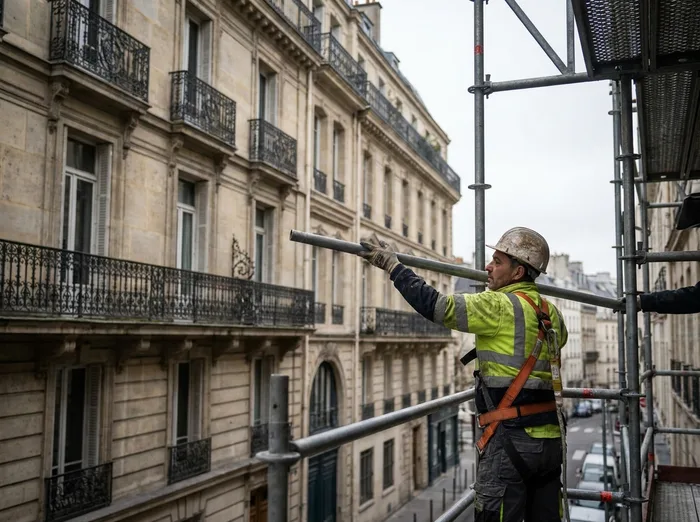
- Civil and commercial construction: Building facade refurbishment, historic building repairs, and new residential complexes require modular scaffolding. Most of this hiring happens in major urban hubs like Prague (Praha), Brno, and Plzeň.
If you prefer outdoor construction, the peak hiring window runs from late February to October. Industrial scaffolding offers more consistent indoor and plant-based work throughout the winter months.
2. The Czech Scaffolder Card: Lešenářský Průkaz
You cannot legally erect or dismantle scaffolding on a Czech work site without meeting national safety standards. In Czechia, occupational safety for work at heights is governed by Czech Government Regulation No. 362/2005 Coll. and national technical standards (such as ČSN 73 8101 for scaffolding).
To work legally as a qualified scaffolder, you must hold a valid Czech scaffolder card, known as a Lešenářský průkaz. This card is issued by accredited safety training institutions in Czechia after you complete a brief theoretical and practical course covering local safety laws, knot tying, anchor systems, load calculations, and inspection rules.
What this means for non-EU workers:
- Foreign certifications: Your local license or CISRS card from abroad proves your experience to an employer, but it does not automatically replace the Czech credential on paper.
- Employer training: Most reputable Czech employers will arrange and pay for your local safety training course and medical fitness check (*lekářská prohlídka*) during your first week after arriving in the country.
- System familiarity: Most Czech commercial sites use standard European modular systems like Layher Allround, Layher Speedy, Peri UP, or Alfix. If you already know how to assemble Layher or Peri systems, state this clearly to employers, as tube-and-fitting scaffolding is far less common in Czechia today.
3. Work Permits and Visa Routes for Non-EU Workers
You cannot work in Czechia on a tourist visa or a visa issued by another Schengen country. You must obtain a legal work permit before starting work. For non-EU citizens, the primary legal route is the Employee Card (Zaměstnanecká karta).
The Employee Card is a long-term dual permit that combines a residence permit and a work authorization for a specific job position registered with the Czech Labour Office (*Úřad práce*).
Here is how the hiring process works step-by-step:
- Job registration: A Czech employer lists an open scaffolder position on the official Czech Labour Office job database.
- Labor market test: The position must remain open for Czech and EU citizens for 10 to 30 days. If no local worker fills it, the job receives a vacancy reference number suitable for non-EU hiring.
- Work contract: The employer sends you an official employment contract or a binding job offer that meets national minimum wage requirements.
- Embassy appointment: You apply for the Employee Card at the Czech embassy or consulate in your home country (for example, in New Delhi, Manila, Tashkent, or Belgrade).
- Processing time: Visa processing usually takes between 60 and 120 days. Do not travel to Europe until your visa sticker is approved and placed in your passport.
4. Realistic Pay, Working Hours, and Seasonal Cycles
Pay in Czechia is calculated in Czech Koruna (CZK). While job adverts sometimes show gross monthly salary, what matters to you is net pay (the money deposited into your bank account after income tax, social security, and health insurance deductions).
As of 2026, typical pay rates for foreign scaffolders in Czechia fall into these ranges:
- Basic net monthly pay: Between 30,000 CZK and 42,000 CZK (approximately 1,200 EUR to 1,700 EUR) for standard 160 to 170 monthly hours.
- Experienced lead scaffolders: Between 42,000 CZK and 52,000 CZK net per month when working extra hours or holding team-lead responsibilities.
- Hourly net equivalent: Most workers earn between 170 CZK and 240 CZK net per hour.
- Overtime and weekend pay: Working extra hours or weekend shifts adds premium pay rates required by Czech labor law.
- Accommodation assistance: Many employers provide subsidized or free company housing in worker hostels (*ubytovna*). If accommodation is included, your net cash wage might be slightly lower, but your living costs drop significantly.
The work cycle relies on weather conditions. Commercial scaffolding picks up sharply in spring (March/April) and runs hot through autumn (October/November). During cold winter months (December through February), sub-zero temperatures and ice make high-altitude scaffolding dangerous, leading to reduced hours on commercial sites. Industrial plant maintenance remains active year-round.
5. Reality Check: Common Misconceptions About Scaffolding in Czechia
It is easy to get misleading information online. Here are the facts regarding common mistakes workers make:
- Myth 1: You can start work on a Polish work visa.
Fact: A Polish work visa does not give you the legal right to work directly for a Czech construction company. Working long-term in Czechia on a foreign visa without official cross-border posting paperwork can result in deportation and a Schengen entry ban. - Myth 2: You do not need physical fitness checks.
Fact: Czech law mandates a thorough occupational health assessment before you start work at heights. Doctors test your eyesight, blood pressure, balance, and heart condition. If you fail the high-altitude medical exam, you cannot be hired as a scaffolder. - Myth 3: Tube-and-fitting experience is enough.
Fact: While basic scaffolding principles apply everywhere, modern Czech sites run almost exclusively on system scaffolding (Layher, Peri, Plettac). If you only know traditional pipe and coupler systems, you must adapt quickly to system scaffolding. - Myth 4: You will easily earn German wages in Prague.
Fact: Czech wages are competitive for the local cost of living, but they are lower than in Western Europe. Czechia offers a reliable entry route into legal European employment, but pay scales reflect the local economy.
6. Language and Daily Work Culture on Czech Sites
You do not need to speak fluent Czech to secure an entry-level scaffolding job, but knowing basic construction terms gives you a massive advantage. On multi-national job sites, team leaders (*parťák*) or site managers (*stavbyvedoucí*) direct work crews.
On many sites, teams communicate in basic Czech, English, or Russian. However, site safety briefings, emergency procedures, and signboards are written in Czech. Learning standard Czech commands for tools, directional movements, safety gear, and emergency instructions will make your daily work safer and earn you respect from your crew.
Czech site culture values punctuality, strict compliance with safety harness usage (*postroj*), and sober behavior. Czech job sites enforce a zero-tolerance policy for alcohol and drugs, with frequent breathalyzer checks at site entrance gates.
7. Put Your Specifics Into Your Workuro Profile
Czech employers search Workuro directly to find experienced workers for open Labour Office vacancies. To stand out to hiring managers and recruitment teams in Czechia, make sure your Workuro profile includes exact details rather than vague summaries.
When updating your profile, ensure you explicitly mention:
- Specific systems you know: List exact modular brand names like Layher Allround, Peri UP, or Alfix.
- Your height certification: Mention any past high-altitude safety training, rigging certificates, or local safety cards you hold.
- Target regions in Czechia: Indicate if you are ready to work in industrial regions like Ústí nad Labem, Litvínov, Ostrava, or major cities like Prague, Brno, or Plzeň.
- Language capabilities: List your level of English, Czech, or any other European languages, even if basic.
- Document readiness: Note whether you hold a valid international passport ready for Employee Card visa processing.
A complete profile with clear work history helps Czech construction companies find you faster when they need to fill foreign worker quotas.
Готові, щоб вас знайшли?
Створіть профіль за 2 хвилини. Безкоштовно, без картки.
Читати далі