Scaffolder Jobs in France for Foreign Workers (2026)
 France
Scaffolding demand in France for 2026
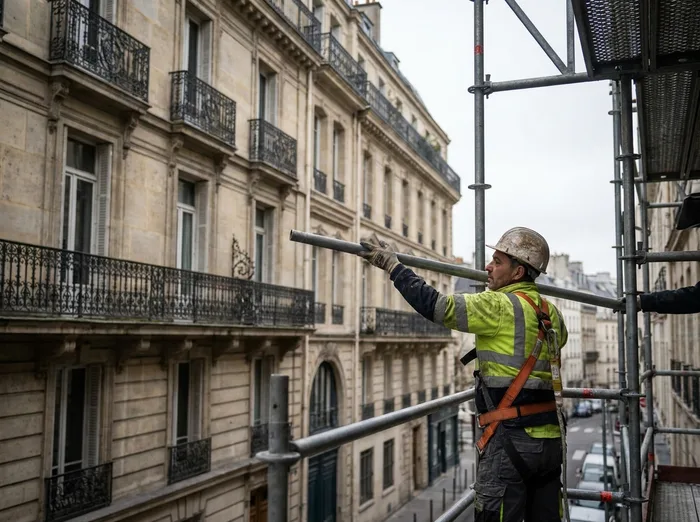
France is spending billions of euros on major infrastructure, energy projects, and urban renovation. Because of this, scaffolding workers (known in France as échafaudeurs) are in high demand across several key regions. If you are a non-EU worker with solid experience in building, modifying, and dismantling heavy scaffolding structures, French employers are actively looking for your skills in 2026.
The strongest hiring is concentrated in specific industrial and metropolitan areas rather than small rural towns. You will find the highest concentration of scaffolding jobs in these regions:
- Île-de-France (Greater Paris): Mega-projects like the Grand Paris Express rail expansion and massive residential energy retrofits require thousands of temporary structures every day.
- Normandy (Le Havre and Rouen): A top industrial zone with sea ports, chemical plants, and refineries that need constant maintenance and turnaround scaffolding.
- Provence-Alpes-Côte d'Azur (Fos-sur-Mer and Marseille): Major industrial coastlines dominated by shipyards, steelworks, and oil terminals.
- Auvergne-Rhône-Alpes (Lyon corridor): Known as the Chemical Valley, this area has a constant need for industrial scaffolders for plant shutdowns and upgrades.
If you prefer residential scaffolding, major cities like Paris, Lyon, and Marseille hire year-round. If you specialize in industrial, refinery, or shipyard scaffolding, coastal and river port zones offer high seasonal peaks, especially during spring and autumn plant maintenance shutdowns (arrêts de tranche).
Work permits and visa routes for non-EU scaffolders
As a worker coming from outside the European Union, you cannot simply arrive in France and start looking for a job. You must secure a job offer first, after which your prospective French employer applies for an official work permit on your behalf.
The primary route to work legally in France involves these steps:
- Shortage occupation status: Scaffolding and general construction site roles appear on France's list of regional shortage occupations (métiers en tension). When a job is on this list in a specific department, the employer does not have to prove that they tried to hire a French or EU citizen first. This speeds up your application significantly.
- Work permit application (ANEF): Your employer submits the request online through the French foreign labor portal (ANEF). They must submit your employment contract, details of your job qualifications, and proof of company registration.
- DREETS authorization: The regional labor authority (DREETS) reviews the contract. They check that the wage offered meets French labor law standards and that your working conditions match local collective bargaining rules.
- Visa processing: Once DREETS approves the permit, the file goes to the French embassy or consulate in your home country. You then apply for a long-stay visa equivalent to a residence permit (VLS-TS). This process usually takes between six weeks and three months from start to finish.
Required certifications and safety standards in France
France has strict rules regarding site safety. You cannot step onto a French building site to assemble scaffolding without recognized training and health clearances. If you learned the trade in a non-EU country, your foreign certificate will not automatically qualify you on a French site, but your practical experience makes it easier to complete local certification.
Here are the key standards you must know:
- CACES R408 certification: This is the official national standard issued under the guidance of the national health insurance body (INRS / CARSAT). The CACES R408 certificate covers the assembly, modification, and dismantling of fixed scaffolding (échafaudages de pied). A related certification, CACES R409, covers mobile tower scaffolding. Most employers require R408 as a baseline.
- Employer training (Notice Technologique): Even if you complete a quick practical assessment, your employer must issue an official authorization (autorisation de montage-démontage) proving you understand the specific manufacturer manuals (like Layher or Mills equipment) used on their sites.
- Medical fitness clearance (VIP): Before your first day on high-structure work, you must pass a medical check called the Visite d'Information et de Prévention conducted by an occupational medical officer in France. This confirms you have no vertigo or health conditions that make working at heights dangerous.
Pay rates, collective agreements, and working hours
Pay in France is protected by national law and sector-specific collective agreements. For scaffolding, your contract will fall under the National Construction Collective Agreement (Convention Collective Nationale du Bâtiment) or the Industrial Maintenance Agreement.
Pay rates are based on a worker classification grid running from basic site worker (Niveau I) to highly skilled team leader (Niveau IV):
- Basic monthly net pay: An entry-level scaffolding worker can expect a starting net monthly salary of approximately €1,700 to €1,850 after tax and social security deductions.
- Experienced scaffolders: Skilled workers with several years of experience and certified assembly skills earn between €1,900 and €2,400 net per month for standard hours.
- Food allowances (Prime de panier): Construction workers in France receive a tax-free daily lunch allowance, usually between €10 and €15 per day worked, paid on top of standard wages.
- Travel allowances (Grand Déplacement): If your employer sends you to work on an industrial site far from your main place of residence, you receive daily allowances to cover housing and meal costs. This can add several hundred euros to your monthly earnings.
- Standard hours: The official working week in France is 35 hours. Any additional hours are treated as overtime and paid at enhanced rates (typically +25% for the first eight hours of overtime).
French language expectations and daily site life
Language is a safety issue on a construction site. While you do not need fluent French to get hired, you must know enough to understand instructions, read danger signs, and participate in daily site briefings.
- Language level needed: Aim for a practical A2 level of spoken French. You must be able to understand health and safety rules, emergency alerts, and direct commands from your site supervisor (chef d'équipe).
- Safety briefings (Quart d'heure sécurité): Every week or at the start of a new job, teams hold a fifteen-minute safety meeting in French. Understanding what is discussed is mandatory for all site personnel.
- Personal protective equipment (EPI): French regulations strictly enforce the use of safety equipment. Employers supply your safety harness, double lanyards with shock absorbers, hard hat with chin strap, high-visibility vest, and steel-toe safety boots. Working without proper safety gear leads to immediate removal from the site.
Reality check: What workers get wrong about France
To avoid costly mistakes during your application, keep these factual realities in mind:
- You cannot work legally on a tourist visa: Arriving in France on a visitor visa and trying to work off the record is illegal. Employers face massive fines for hiring illegal workers, and you risk deportation and a ban from entering the Schengen zone.
- Gross salary is not what you keep: French job offers state the gross salary (salaire brut). Social security, health insurance, and pension contributions reduce this amount by around 22% to reach your net take-home pay (salaire net).
- English is rarely spoken on job sites: Do not count on supervisors speaking English. Learning basic French trade terms (such as amarrage for anchoring or croisillon for diagonal bracing) before you arrive is essential.
- Foreign trade certificates do not skip French safety checks: Years of experience in your home country are valuable, but French labor inspectors require local safety cards like CACES R408 on site.
Build your Workuro profile to reach French employers
French construction and industrial companies look for specific skills when hiring from outside the EU. When you create your free Workuro profile, make sure you include exact details so employers can match your experience to open positions in France.
Be sure to highlight:
- Your experience with specific scaffolding brands used in Europe (such as Layher, Mills, or Comabi).
- Any safety certifications or height-work credentials you hold from your home country.
- Your current French language ability, even if you are at a beginner level.
- The French regions you are willing to move to, such as Île-de-France, Normandy, or Provence-Alpes-Côte d'Azur.
- Your complete work history building suspended, modular, or heavy industrial scaffolding structures.
Filling out these details completely helps French employers find your profile when they search for qualified scaffolders ready for visa sponsorship.
Готові, щоб вас знайшли?
Створіть профіль за 2 хвилини. Безкоштовно, без картки.
Читати далі