Cleaner and Housekeeping Worker Jobs in Lithuania for Foreign Workers (2026)
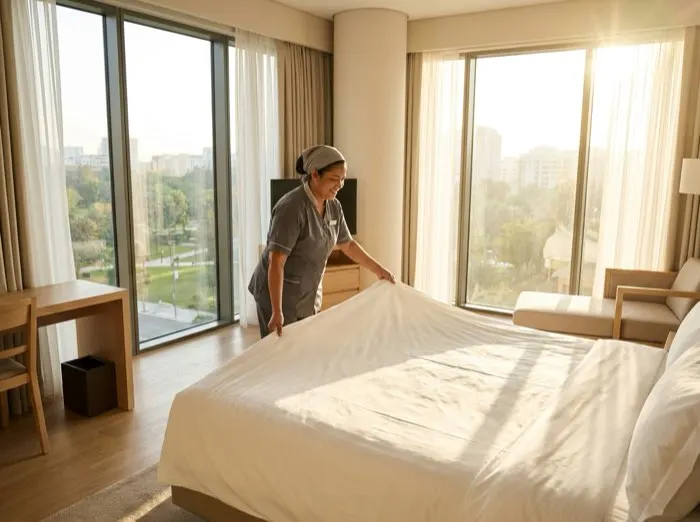
If you are looking for job opportunities in Europe as a non-EU worker, cleaning and housekeeping roles offer a clear entry route into the Baltic region. Lithuania has a growing commercial property market, expanding hotel networks, and year-round spa resorts that continuously require dedicated facility care staff. While immigration rules across Europe have grown more detailed, Lithuanian employers actively recruit foreign staff when local labor is scarce.
This guide explains how the cleaning and housekeeping sector works in Lithuania for non-EU nationals in 2026. You will learn about key hiring cities, real salary ranges after tax, mandatory health certificates, and the exact steps required to secure a legal work permit.
1. The Job Market for Foreign Cleaners in Lithuania
The demand for cleaning and housekeeping workers in Lithuania is steady, but it varies sharply depending on the sector and city. Commercial office buildings, shopping centers, logistics parks, and hospitality businesses rely heavily on professional cleaning teams. If you come from outside the European Union (EU), you will need a formal job offer and a work permit before you can begin working in the country.
Lithuania regulates non-EU labor through annual quotas and market testing. Cleaning is not always on the official national short-supply occupation list, which means your prospective employer must usually list the job locally first. Once the local labor office confirms that no local or EU citizen is available for the role, the employer can request approval to hire you. Demand is strongest in major urban hubs and seasonal coastal zones, making targeted applications key to your success.
If you are primarily looking for immediate, high-volume entry without market testing, nearby countries like Poland or western markets may offer slightly larger worker quotas for general labor. However, Lithuania remains an attractive target due to transparent labor laws, affordable living costs outside the capital, and straightforward residency processing through online government portals.
2. Work Permits, Visas, and Health Certificates
To work legally in Lithuania, you must follow a structured migration process managed by official state bodies. You cannot travel to Lithuania on a tourist visa and start working. Every step must be completed before you begin your employment.
- Employment Service Approval: Your Lithuanian employer applies for a work permit or a decision on compliance with labor market needs through the Lithuanian Employment Service (Užimtumo tarnyba).
- MIGRIS Registration: After the Employment Service approves your application, you apply for a Temporary Residence Permit (TRP) or a National Visa D using MIGRIS, the official online Migration Department portal.
- Health Knowledge Certificate: Cleaners and housekeepers in public or hospitality spaces must complete mandatory hygiene and first aid training to earn a Health Knowledge Certificate (sveikatos žinių atestavimo pažymėjimas), issued by accredited public health centers in Lithuania.
- Medical Clearance Passport: Before starting work, you must pass a medical checkup at a certified Lithuanian clinic to receive your medical booklet (sveikatos pasas / Form 047/a), proving you are fit for physical work and free from communicable diseases.
- Clean Criminal Record: You must present an apostilled or legalized police clearance certificate from your home country during the visa application process.
3. Pay Rates and Living Costs in Lithuania
Wages in Lithuania are governed by national minimum wage legislation and formal employment contracts. Cleaners and housekeepers are paid standard hourly or monthly rates, with higher compensation for night shifts, weekend work, or heavy industrial environments.
- General Net Pay Range: Typical monthly net pay for full-time room attendants, general office cleaners, and residential housekeeping staff ranges between €700 and €1,000 net per month after taxes.
- Specialized and Night Shift Pay: Deep cleaning specialists, industrial facility cleaners in port zones, and late-night commercial maintenance staff earn between €850 and €1,100 net per month.
- Tax Deductions: Employers deduct Personal Income Tax (GPM) and Social Insurance contributions (Sodra) directly from your gross wage, leaving you with your clear net earnings.
- Housing and Utilities: Some hospitality employers, especially in resort towns, provide shared staff housing or subsidize accommodation costs, which significantly reduces your monthly expenses.
4. Key Regions and Hiring Cycles
Job availability changes depending on the season and location. Understanding where employers operate helps you choose the right location when setting up your job search.
- Vilnius Region: As the capital, Vilnius offers year-round demand for corporate office cleaners, diplomatic facility staff, and hotel room attendants. Large shopping centers like Akropolis and Ozas hire commercial cleaning crews on continuous shift schedules.
- Kaunas Region: Kaunas is a major logistics and manufacturing center. Hiring focuses heavily on industrial facility maintenance, warehouse cleaning, and commercial property care within the Kaunas Free Economic Zone (FEZ).
- Klaipėda Port Area: Klaipėda requires specialized industrial and maritime facility cleaners. The job market remains steady throughout the year due to active port logistics, commercial shipping, and surrounding industrial sites.
- Palanga and Neringa Coastal Resorts: These Baltic coastal towns experience peak hiring from May through September. Hotel housekeepers, guesthouse attendants, and restaurant cleaning staff are in high demand during this summer holiday period.
- Druskininkai and Birštonas Spa Towns: These southern resort towns operate year-round wellness centers and sanatoriums. They offer stable, non-seasonal housekeeping roles in medical spas, rehabilitation facilities, and leisure hotels.
5. Reality Check: Myths vs. Facts
It is easy to find incorrect information online regarding work in Europe. Keep these real conditions in mind as you plan your move:
- Myth: You can enter Lithuania as a tourist and convert to a work permit locally.
Fact: Working on a tourist visa is strictly illegal. Your employer must initiate the legal process while you are legally resident in your home country or hold valid legal status elsewhere. - Myth: You do not need health checks for non-food cleaning jobs.
Fact: Lithuanian labor laws require all hotel, healthcare, and commercial facility staff to obtain official health clearance and a valid health booklet before setting foot on the workplace floor. - Myth: You must speak fluent Lithuanian to land a cleaning role.
Fact: While basic Lithuanian helps with daily life, many commercial night crews and hotel housekeeping teams operate with basic English or Russian communication skills. - Myth: Work permits allow you to change employers immediately.
Fact: Your initial work permit and temporary residence authorization are bound to the specific employer who sponsored you. Changing jobs requires a formal application to MIGRIS for approval.
6. On-the-Job Expectations and Language Requirements
Working as a cleaner or housekeeper in Lithuania requires physical stamina, attention to detail, and awareness of occupational safety standards. Employers provide protective gear, cleaning chemicals, and basic training on equipment usage.
In hotel environments, room attendants are usually assigned a specific quota of rooms per shift. Speed, thoroughness, and respect for guest privacy are essential. In office complexes, work often takes place outside regular business hours, such as early mornings or late evening shifts. While fluent Lithuanian is rarely mandatory for entry-level positions, learning safety terms, chemical hazard labels, and basic task instructions in Lithuanian will help you advance and work safely.
7. Update Your Workuro Profile to Get Found by Employers
Lithuanian employers and recruiting agencies search Workuro to find reliable foreign candidates ready for recruitment. To make your profile stand out to companies looking for cleaners and housekeepers, make sure your profile includes accurate and complete details.
Log into your Workuro profile and make sure you complete these specific sections:
- Target Locations: List specific Lithuanian cities you are prepared to move to, such as Vilnius, Kaunas, Klaipėda, Palanga, or Druskininkai.
- Specific Cleaning Experience: Clearly state whether your background is in hotel room housekeeping, industrial warehouse cleaning, residential care, or corporate office sanitation.
- Health and Safety Training: Mention any existing certificates in chemical safety, sanitation, or medical checks you have completed in previous roles.
- Language Proficiency: State your exact skill level in English, Russian, or any basic Lithuanian phrases you know. Honesty about language helps employers place you in the right team environment.
- Availability: Clearly list when you are ready to start and whether you are aiming for seasonal summer contracts or year-round positions.
By keeping your Workuro profile accurate and detailed, you make it easy for verified employers in Lithuania to find your contact details and reach out to you directly with job offers.
¿Listo para que te encuentren?
Crea tu perfil en 2 minutos. Gratis, sin tarjeta de crédito.
Sigue leyendo